
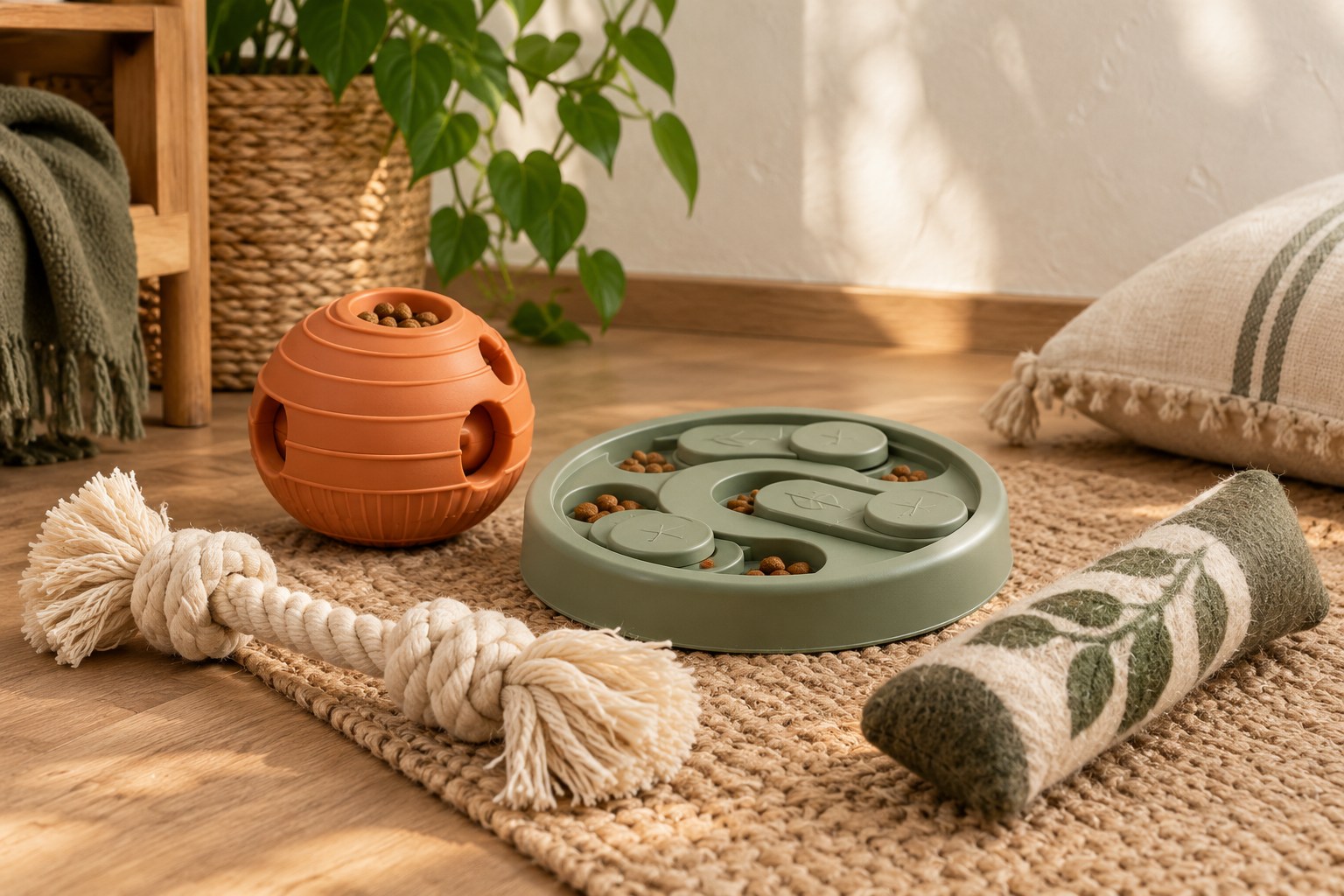
Travel changes the play environment even when the pet's favourite toy stays the same. A familiar ball may roll under hotel furniture, a wand may reach a lamp, and a food puzzle may need washing facilities that are not available. Start with the destination and the care routine, then choose a small kit.
Use equipment already known to suit the individual animal. A trip is a poor time to rely on an untested mechanism or an unfamiliar collection of small parts. Keep play appropriate to the animal's abilities and the space, with supervision required by each product.
Map the likely setting
Think about a room, outdoor rest area, or temporary home as a set of constraints. Check floor grip, open space, nearby roads, furniture gaps, and shared-household needs. A high-bounce ball may be unsuitable in a compact room even if it works well in a garden.
Choose activities that stay within a manageable area. A familiar compact puzzle can be useful if its serving and cleaning requirements can be met. A simple shared toy may be easier than a large modular track that needs careful assembly after every stop.
Pack by role rather than quantity
One familiar comfort-oriented toy and one supervised interactive option may cover more useful ground than several nearly identical objects. Follow the products' intended uses and do not leave equipment accessible merely because it is familiar.
For a hypothetical overnight stay, a washable compact toy and a short supported interactive tool could fit the room better than a launcher. If strings or small attachments are included, carry them in a secure closed container and put them away immediately after each supervised session.
Keep spare parts identified
Pack only the components needed for the selected toys, with compatible spares where appropriate. A clear pouch with a piece count can make setup and collection easier. Keep small loose items inaccessible to the animal during travel.
Do not substitute a hotel object or household accessory when a part is missing. A pen cap is not a replacement ball, and a decorative cord is not a supported wand line. If the kit is incomplete, choose another appropriate activity rather than improvising a new construction.
Plan food-based play separately
If a puzzle uses food, follow the individual's established feeding plan and the food's handling instructions. Check that the toy can be emptied and washed properly at the destination. A sealed travel bag does not make leftover food suitable to remain inside the toy indefinitely.
Keep food-contact equipment separate from dirty outdoor toys. Use suitable closed containers and retain relevant product information. If you cannot provide the required cleaning or storage conditions, choose a non-food play option for that part of the trip.
Give used toys a return route
Include a washable container for dirty or damp equipment, then remove it for cleaning at the first suitable opportunity. Do not leave wet fabric sealed in the kit until the next trip. Reset the bag once home, checking seams, closures, and missing parts.
Before departure from each stop, count the kit's contents and inspect the play area. Look under furniture and around the vehicle for lost toys or components. A small deliberate collection is easier to account for than an overpacked bag whose contents nobody remembers.
For our approach to product claims and illustrations, see the Editorial Policy.