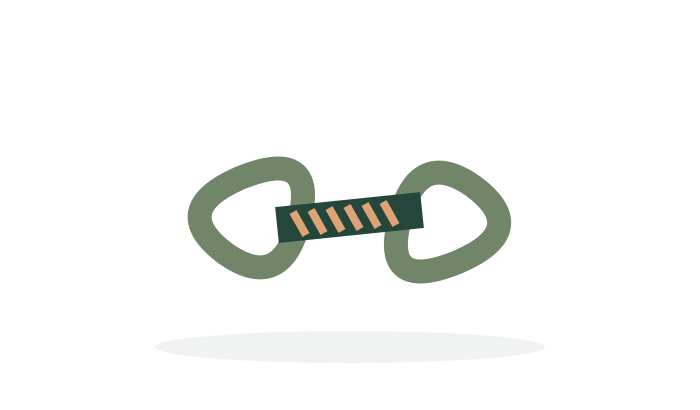
Tug toys use straight handles, loops, rings, and elastic sections to give people different ways to hold them. Each changes the path of force and the amount of movement that occurs when one participant lets go. The most comfortable-looking handle is not necessarily the easiest one to release or control.
Start with a product designed for shared tug play and matched to the animal's size. Keep the interaction controlled, with the animal's feet on the ground. The handle should support a simple grip rather than encourage wrapping, anchoring, or greater pulling intensity.
Compare straight and looped grips
A straight handle can be easy to release, while a loop may offer several holding positions. With either style, keep your hand able to let go immediately. Avoid wrapping the toy around fingers, a wrist, or a fixed object to gain leverage.
Padded handles can improve comfort but hide the webbing or join beneath them. Look for inspection access around the padding and a clear indication of the load-bearing construction. Decorative stitching and thick foam do not establish how securely the handle connects to the toy.
Understand what stretch adds
An elastic or bungee section stores and releases movement. That can alter the feel of a gentle pull, but it also creates recoil if a grip is lost. Read the maker's intended handling and consider the space around both participants before choosing a stretchy design.
Do not stretch the toy toward faces or treat maximum extension as a target. A hypothetical short room with furniture close behind the person may be better suited to a simple nonelastic tug than a long bungee toy. More movement is not automatically more useful movement.
Look at ring geometry
A ring provides a continuous grip area and can make separation between hands and mouth clearer when sized appropriately. It can also place grips close together if the diameter is small. Check both overall diameter and the thickness of the ring section.
A soft ring and a rigid ring behave differently when held. Follow the product's intended use and avoid hard objects that are not designed for this activity. If the animal's gripping area repeatedly moves toward the hand, stop and reset rather than chasing a safe position around the circle.
Inspect the transition points
The most visually prominent part may not be the weakest point. Examine where webbing enters a padded handle, where elastic joins a fabric body, and where a ring is moulded or stitched. Flex the empty toy gently as permitted to make hidden damage easier to see.
Remove a toy with torn stitching, exposed internal elastic, cracked material, or loose fittings. Do not repair a high-load join with a household knot or adhesive and assume original performance remains. Use a manufacturer-supported replacement or choose another toy.
Keep the shared routine simple
Introduce the toy in a clear area and use a grip that leaves adequate distance. Pause when the animal changes to chewing, grabs clothing, or makes the interaction difficult to manage. A short reset is more useful than trying to control an escalating session through a stronger handle.
Tug equipment should be put away afterward if it is intended only for shared play. A handle that works well in a person's hand can become an appealing fabric loop when left unattended. Storage is therefore part of selecting the correct design.
Compare cleaning and drying
Elastic sections, foam padding, and dense fabric may have different care limits. Check instructions for the complete product rather than washing according to the outer fabric alone. Allow the inner layers to dry fully, and inspect the joins again when the toy is clean.
If your routine requires frequent washing, a simple design with fewer padded layers may be a better fit. The best handle is one you can grip comfortably, release readily, inspect clearly, and maintain without hiding damage beneath decorative construction.
For our approach to product claims and illustrations, see the Editorial Policy.