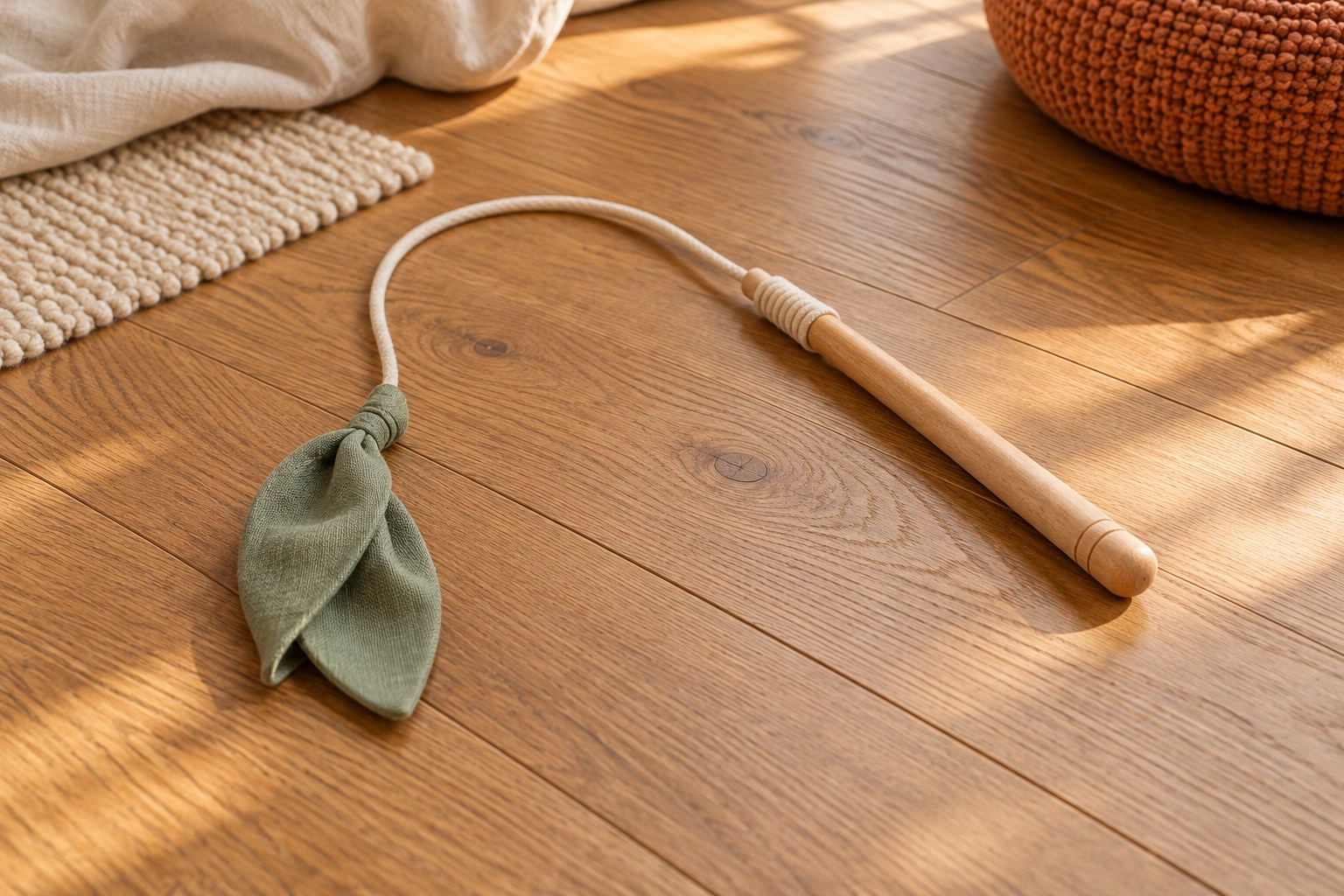
A wand lets a person move a lure while keeping hands separate from the cat's active play area. Its useful range depends on the rod, connecting line, attachment, and available room. A longer wand is not automatically better if the lure repeatedly catches on furniture or becomes difficult to control.
Treat strings, ribbons, elastic, and attached lures as supervised equipment. Put the complete toy away securely after play, where the cat cannot retrieve it. A toy hanging from a door handle or draped over a shelf remains accessible even when the session is supposedly finished.
Match reach to the room
Measure a clear movement area and consider where the person can sit or stand comfortably. The combined rod and line length determines the lure's range. A compact room may suit a shorter line and more controlled movements than an open floor.
Check whether a telescopic rod locks as intended and whether the tip remains secure. A rod that collapses unexpectedly can change the lure's path. Follow the maker's setup instructions rather than extending parts beyond their supported length for extra reach.
Look at the lure's motion
Different lures drag, flutter, roll, or pause differently. Choose a construction appropriate for the cat and inspect feathers, fabric strips, small eyes, bells, and other fittings. A realistic appearance is less important than secure construction and manageable movement.
Move the lure away from the cat and along accessible routes rather than repeatedly pushing it into the face. Allow pauses and opportunities to approach. Keep movements within the animal's abilities, avoiding high repeated leaps or abrupt turns near furniture.
Check line and connector details
Read what connects the lure to the rod: cord, wire, ribbon, or elastic. Each has different handling and inspection requirements. Elastic adds recoil, while long fine lines can be difficult to see against furniture. Keep the line clear of the cat's body and the person's hands.
If a clip allows replacement lures, inspect its closure before every session. Use only compatible attachments and keep the hard connector away from the active gripping area as the design intends. Do not improvise dangling jewellery, household thread, or small accessories as lures.
Build a controlled play sequence
Start with modest movement and watch the cat's chosen approach. A lure dragged around a low obstacle may invite stalking, while one constantly airborne may produce a very different session. Change one presentation detail at a time so you can see what works.
For a hypothetical small living room, a short route around a plain box with clear exits may be easier to manage than sweeping the lure across a sofa and lamp table. The surroundings should support safe movement rather than create a dramatic obstacle course.
Finish by accounting for parts
Let the session end calmly and collect the lure, line, rod, and any detachable components. Inspect for missing pieces, frayed material, or a connector that has opened. A damaged attachment should be retired before it returns to the storage container.
If the cat grips the lure, avoid yanking it away with the line taut. Pause and manage the exchange calmly using an appropriate familiar method. Pulling harder can damage the toy and make the shared interaction less controlled.
Make secure storage part of the purchase
Choose a closed storage location long enough for the rod or a supported way to shorten it. Keep replacement lures and loose connectors in the same secured area, separately contained. An open basket is not suitable for strings and small attachments the cat can retrieve.
Consider washing requirements for removable fabric parts and dry them fully before storage. A simple wand with a well-understood attachment can be more practical than a collection of elaborate lures. The useful design is one you can control during play and reliably remove from access afterward.
For our approach to product claims and illustrations, see the Editorial Policy.