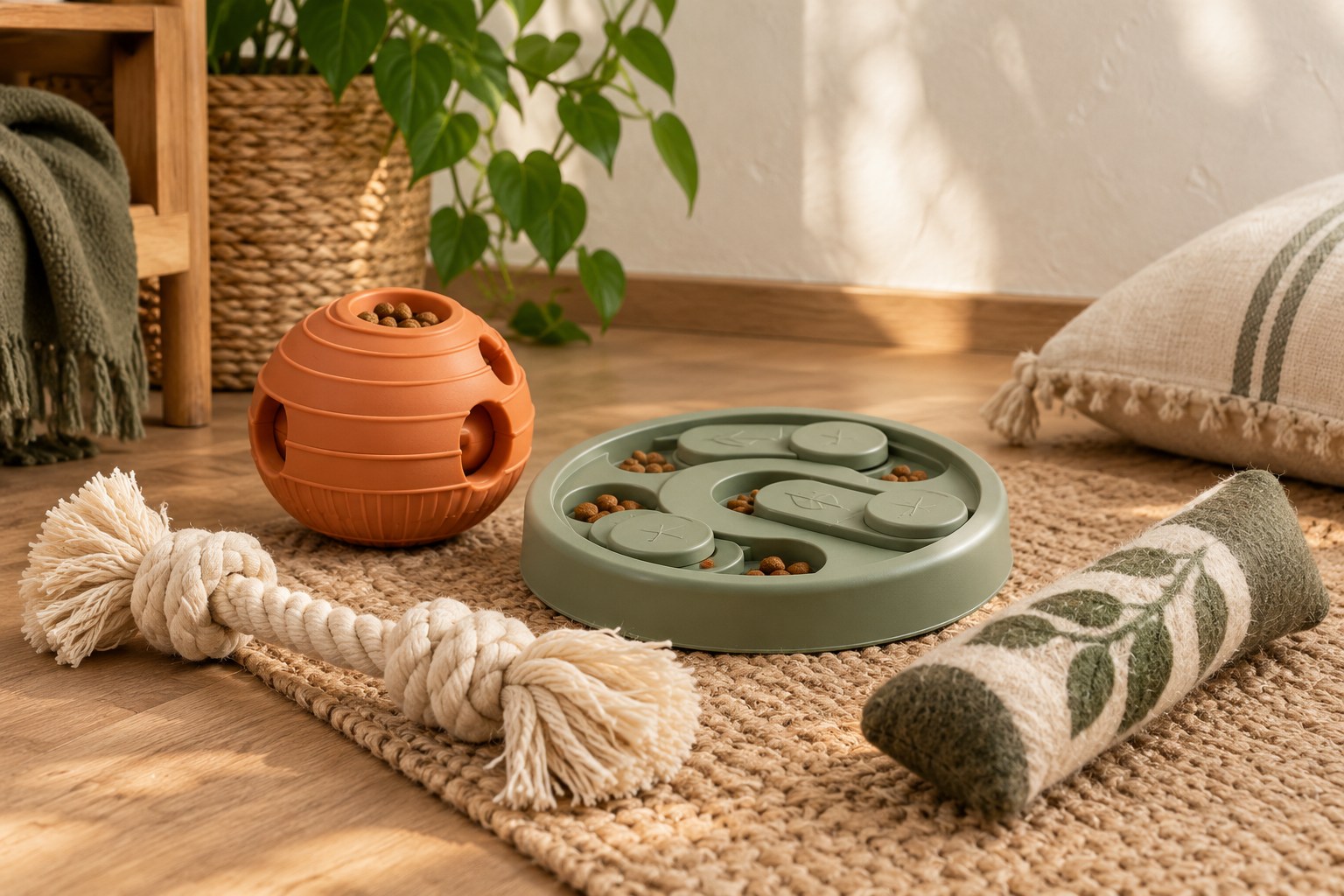
In a multi-cat home, the most visible animal can dominate your impression of whether a toy works. One cat may approach quickly while another watches from a doorway and never joins. An empty food puzzle or frequently moving ball shows activity, but it does not establish comfortable access for everyone.
Begin by observing individual preferences and the room layout. Equipment can support separate opportunities, but it cannot make a narrow corner or crowded approach disappear. The goal is to offer manageable access and clear choices rather than persuade every cat to use the same object together.
Map approaches and exits
Look at the play area from floor level. Can a cat approach from more than one direction and leave without squeezing past another animal? A toy at the end of a corridor can create a very different interaction from the same toy in an open area.
Keep doorways and ordinary routes clear. Large tracks, puzzle boards, and storage boxes should not become barriers. If you use more than one station, place them with meaningful separation rather than clustering every object in one busy corner.
Observe one cat at a time
Offer individual supervised opportunities where practical and appropriate. This reveals whether a cat likes the mechanism when another animal is not already occupying it. Watch approach, use, and departure rather than only counting how often the object moves.
For a hypothetical pair of cats, one may prefer a wand dragged along the floor while the other follows a compact batting toy. Buying two identical wands may not address that difference. A varied collection can be more useful than duplicates when preferences are distinct.
Use duplicates for a defined reason
Two similar toys can help when both cats seek the same activity, but spacing still matters. Adjacent bowls in a puzzle or balls in one track remain part of a shared station. Separate objects in different locations may provide clearer individual access.
Check that each duplicate is appropriately sized and intact. Avoid assigning the older damaged toy to the less assertive animal or assuming familiar equipment is automatically suitable. Inspection and cleaning standards should be the same across the collection.
Manage shared interactive equipment
A person controlling a wand can inadvertently direct both cats toward one narrow target. Keep sessions observed and adjust the arrangement if the interaction becomes difficult to manage. Separate turns or separate suitable spaces may be more practical than trying to maintain constant simultaneous attention.
Strings, ribbons, and elastic must be stored securely after supervised play. Having several cats does not make unattended wand equipment safer. Account for every lure and connector so one animal cannot retrieve a forgotten component after the session.
Choose visible, maintainable stations
Large modular toys can hide which cat is using which section. A simpler low setup may make observation easier. If a food puzzle is involved, use individually appropriate food and serving arrangements, and verify access directly rather than relying on an empty compartment.
Clean shared equipment according to its instructions and inspect between sessions. More users can mean more handling and more opportunities for a clip to loosen. Keep replacement parts identified so an incompatible ball or attachment is not introduced during a quick repair.
Review the arrangement over time
Preferences and household routines can change. Keep short observations such as uses track when area is quiet or leaves when second cat approaches. These details guide equipment placement more effectively than labels about one cat being universally playful or uninterested.
If a toy remains unused, try a suitable individual opportunity before deciding it has no value. If the arrangement consistently creates conflict or prevents comfortable access, seek appropriate individual guidance and change the setup. More elaborate equipment is not a substitute for a workable shared environment.
For our approach to product claims and illustrations, see the Editorial Policy.