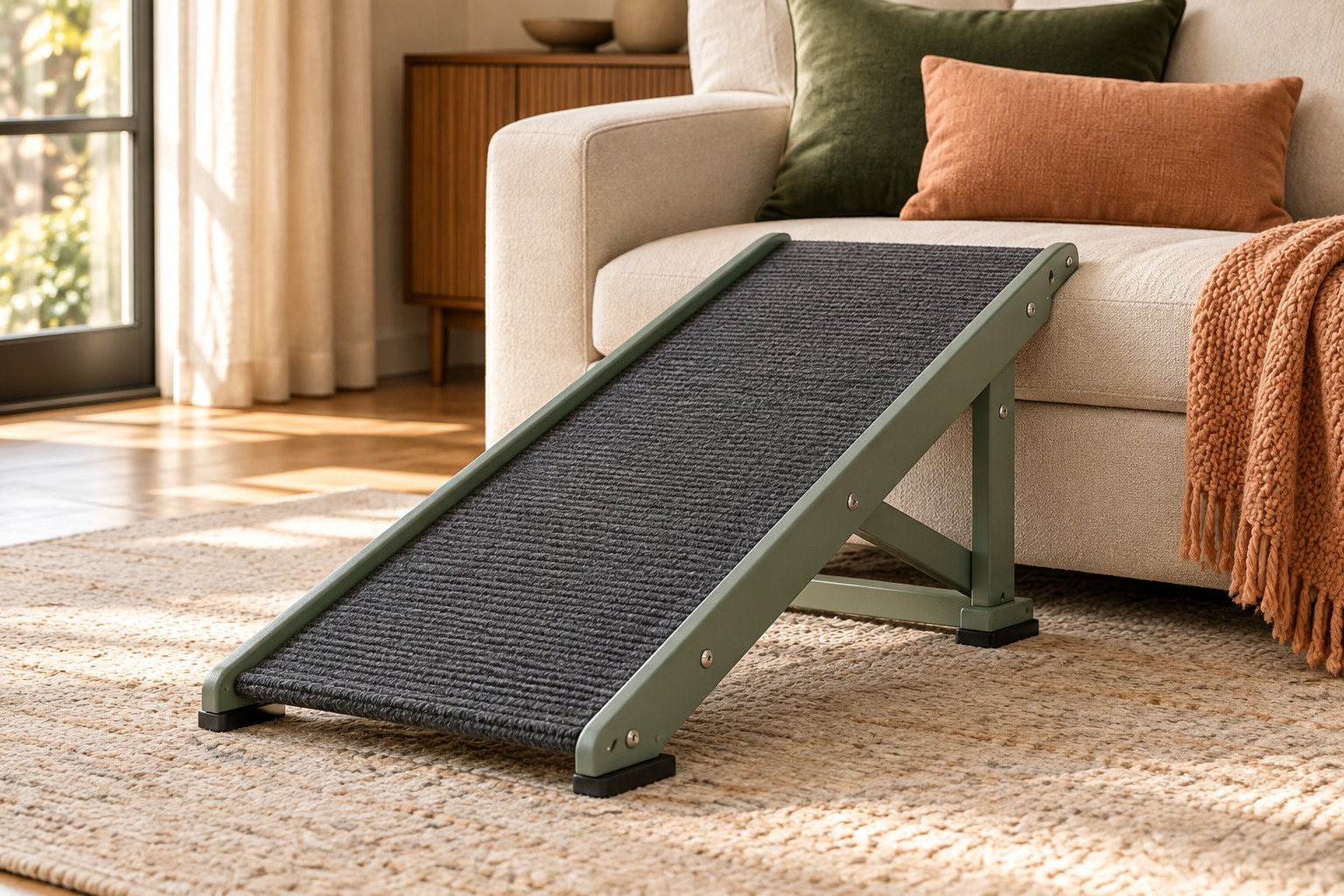
Traction is often advertised through a close-up of a rough panel. That panel matters, but the ramp also relies on contact at its upper and lower ends. A sound walking surface on a moving frame is not a useful system. Evaluate the entire route and the conditions that can change its behavior, especially water, dirt, and ordinary wear.
Compare the texture thoughtfully
Carpet-like material, rubberized panels, and abrasive-looking surfaces provide different contact patterns. Read what the maker intends and whether replacement panels are available. A coarse surface is not automatically better for every pet. Check for loose fibers, rough edges, exposed staples or fasteners, and changes at joints. The animal needs an appropriate continuous walking area rather than a visually aggressive texture.
Raised ribs may help define the path, but their spacing and height still need to suit the individual user. Do not assume that a pattern shown with a large dog will work equally well for a small pet. If mobility is a concern, obtain veterinary guidance on the access setup. Product photographs cannot establish the pet's ability or comfort on a particular incline and texture.
Inspect both ends before every use
Lower feet should sit on firm compatible ground without rocking or resting on loose debris. The upper lip needs the contact described by the manufacturer. Check whether a retaining feature is required and use it exactly as instructed. A ramp placed against a rounded or unsuitable surface may shift even when its top texture looks excellent.
Rain, mud, and cleaning residue can change contact. Wipe or clean the relevant surfaces as directed before deployment and do not use the ramp where conditions exceed its instructions. Avoid placing it on a loose household rug to make the ground softer. That adds another moving layer beneath the feet and can undermine an otherwise careful setup.
Look at wear patterns
The center may wear differently from the edges, and a frequently used entry point can become smooth before the rest of the panel appears old. Inspect the full path under good light. Check glued edges for lifting and replaceable strips for secure attachment. A flap that catches a paw is a reason to stop using the ramp until the surface is restored through an approved method.
Do not add a random abrasive tape without considering the product instructions and the pet's contact with it. Adhesives can lift, leave residue, or interact with the original surface. A compatible replacement part has a defined fit and installation method. If no suitable repair exists, replacing the ramp may be more practical than layering several materials over a deteriorating panel.
Keep cleaning compatible with the mechanism
Remove dirt from traction, feet, and upper contact according to the care instructions. A carpeted surface may dry differently from a molded panel, and telescoping tracks can retain material where it is not visible. Dry the ramp fully before folding or sliding it closed. Moisture trapped between sections can complicate storage and hide deterioration until the next use.
Avoid cleaning products that leave a slippery film, and follow any required rinsing process. Never apply a general-purpose lubricant to a walking panel. If the mechanism needs maintenance, use only the maker's specified method and keep the working surface clear. Good care preserves the intended product instead of creating a new untested combination of coatings and textures.
Introduce the complete surface
Practice in an appropriate controlled plan and keep the pet away during setup. A sound ramp should be stable before the animal approaches it. Do not force crossing when the pet hesitates; reassess the angle, location, texture, and individual needs. Keep an appropriate handler position without blocking the route or pulling the animal into an uncomfortable movement.
Remove the ramp when it is not being supervised and secure it for storage or travel. Its traction features do not make it a permanent staircase in every setting. Revisit the setup if the pet's movement changes or a new vehicle creates different contact. The useful comparison remains the whole stable path, not just the roughness of a small photographed section.

For our approach to product claims and illustrations, see the Editorial Policy.