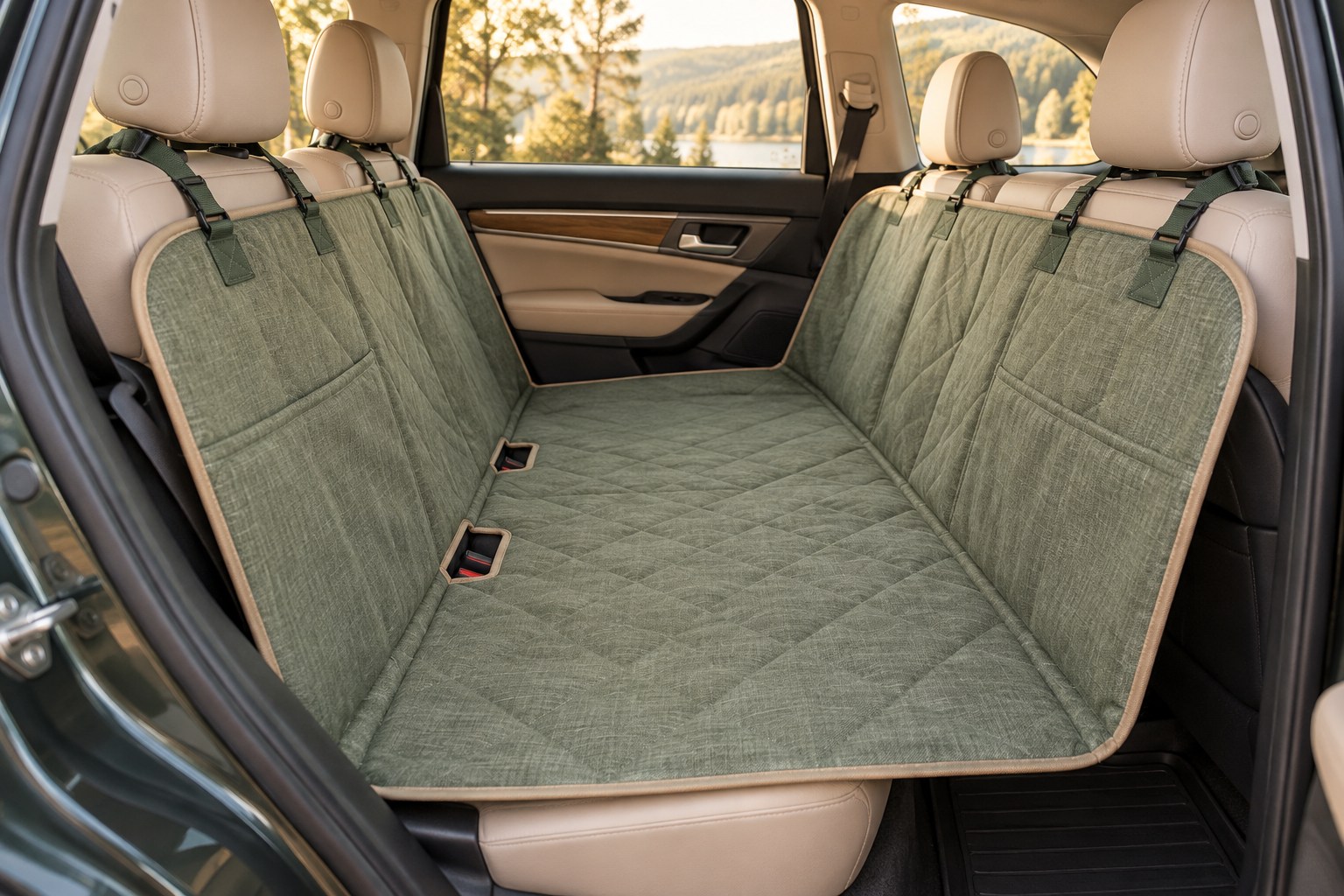
A car hammock hangs between the front and rear headrests to form a fabric surface across the back seat. It can help contain hair and ordinary dirt and reduce direct contact with upholstery. Those functions are separate from restraining the animal during sudden movement. Evaluate the cover around an appropriate travel-restraint plan rather than letting the hammock become the plan itself.
Match the seat geometry
Measure the rear bench width and the distance between attachment points according to the cover maker's guidance. Check how the headrests adjust and whether the product's straps are compatible with them. A cover stretched too tightly can pull away from the seat, while excessive fabric can bunch around paws. Side flaps should clear the doors and not interfere with their normal closing.
Look at split seats and any passengers who may share the rear area. Some covers unzip into sections, but the resulting configuration needs to be permitted by the instructions. Do not assume an opened panel retains the same support as the full hammock. If the vehicle's layout makes a hammock awkward, a fitted bench liner may provide cleaner coverage without introducing a suspended front panel.
Understand anchors and load-bearing claims
Seat anchors and straps may hold the cover in place during ordinary use. That is different from a documented restraint attachment. A fabric bridge across a footwell does not prove that it can support every pet in every movement. Read the product's intended role and load information, and keep any safety claim tied to exact-model evidence rather than the appearance of a sturdy panel.
Never attach a pet's restraint to the hammock straps unless an appropriate tested system explicitly requires that configuration. Comfort layers should not introduce new connections into the restraint path. Avoid unapproved extension tethers used merely to reach around a cover. If the intended restraint cannot be installed correctly with the hammock in place, choose a different cover or setup.
Keep necessary openings accessible
Seat-belt openings should align with the actual vehicle hardware and allow correct use without twisting or trapping a belt. A small slit in a convenient-looking place may not match the car. Check the vehicle manual and restraint instructions, including any restrictions on aftermarket covers. Do not cover or obstruct safety equipment to achieve a neater-looking fabric surface.
Zippered side panels can protect door trim, but they also create another step during loading. Open and secure them as instructed before the pet enters, then check that no strap or loose panel is caught in a door. Keep ventilation and observation in view. A tall mesh divider may change visibility without providing meaningful restraint, so evaluate its practical role honestly.
Choose a cleanable surface
A wipeable upper layer is useful for loose dirt, while seams and quilted channels may still need deeper cleaning. Read whether the entire cover can be machine washed and how the backing must dry. Water resistance on the broad panel does not guarantee that liquid cannot pass through openings or stitched joins. Inspect the seat beneath after spills rather than assuming it remained untouched.
Remove the cover in a way that keeps the dirty face away from clean upholstery. Clean straps, anchors, and folded corners as instructed, then dry all layers completely. Check backing compatibility with the seats and stop if it transfers residue or deteriorates. A spare cover may help frequent users, but it should be the same compatible model or separately assessed for fit.
Inspect the setup before journeys
Check that the cover lies correctly, no attachment has loosened, and the animal's actual restraint is installed exactly as instructed. Keep luggage clear of the pet and ventilation. A hammock should not create a hidden storage pocket for heavy loose objects beneath the animal. Review the complete setup after changing vehicles or adding any accessory.
If the pet repeatedly scratches or mouths the hammock, inspect for damage and reassess suitability rather than accepting exposed filling or loose straps as normal wear. The cover is a household-style textile operating in a vehicle environment. Its convenience comes from protecting surfaces and simplifying cleanup while leaving the appropriate transport system fully functional.

For our approach to product claims and illustrations, see the Editorial Policy.