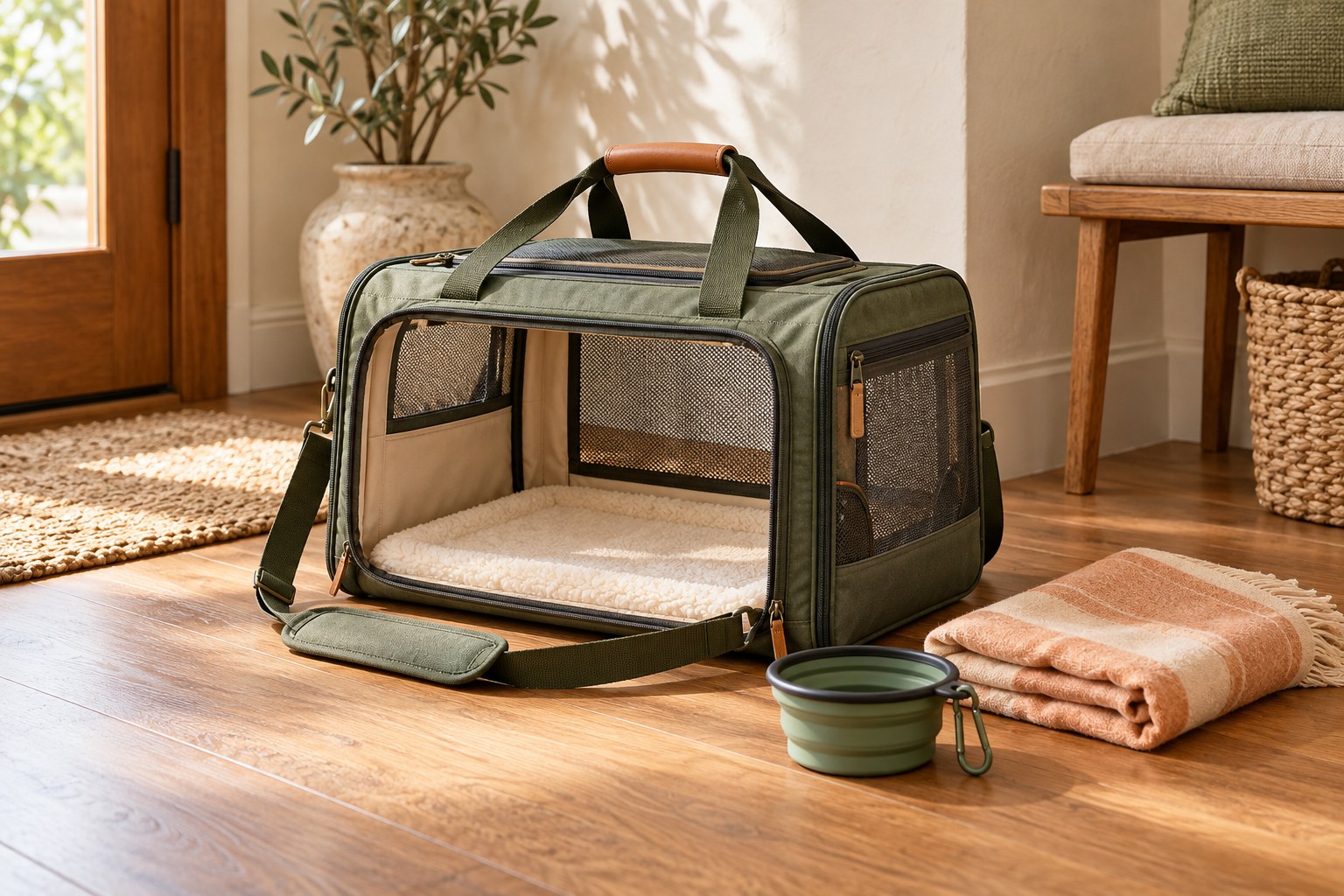
A carrier can look clean from the doorway while moisture remains beneath its pad or residue sits in a zipper seam. Cleaning needs to reach the whole enclosure without damaging the structure that makes it useful. Start by identifying removable parts and the care instructions for each, rather than treating a soft bag and a rigid shell as interchangeable laundry items.
Disassemble only as designed
Remove loose bedding and any intended detachable floor panel. Check whether the shell can be washed, wiped, or disassembled. Some soft carriers contain frames or base materials that should not be immersed, while rigid carriers may have fasteners that need to stay in a particular order. Photograph the arrangement if it helps reassembly, and keep all hardware in a separate secure place.
Do not remove sewn-in structural pieces simply because they are difficult to clean around. Follow the maker's method or ask for guidance. A carrier should not lose its intended support in the pursuit of a convenient washing cycle. If contamination cannot be cleaned appropriately within the product's limits, replacement may be more practical than an improvised treatment that weakens mesh, coatings, or fasteners.
Work through hidden areas
Inspect the floor under the pad, seam lips, zipper tracks, handle attachments, and pocket corners. Remove loose debris according to the instructions before adding moisture. On a hard shell, the join between upper and lower sections may need attention; on a soft bag, mesh borders and folded fabric can hold residue. Use only cleaning products and methods compatible with the material.
Contact time, rinsing, and residue requirements vary by cleaning product. Follow its label and the carrier instructions rather than mixing products or inventing a stronger solution. If the carrier has been used around an infectious illness or unusual contamination, ask a veterinarian for suitable cleaning guidance. Routine household cleaning instructions may not address that situation, and a product article cannot define the appropriate protocol.
Dry the complete assembly
Spread removable pieces so air can reach both faces, and open the shell as allowed by its design. Thick pads and fabric around the base may dry more slowly than mesh. Check corners by touch and inspection before putting the floor panel back. A dry-looking exterior is not enough if a sealed base or padded seam still holds moisture.
Avoid direct heat or a dryer unless the relevant component's care instructions permit it. Heat can affect coatings, adhesives, and shaped inserts differently from ordinary textile. Do not fold a soft carrier tightly for storage while it is still damp. A clean temporary location with the carrier open is preferable to sealing residual moisture in a cupboard or travel bag.
Inspect before returning it to service
Check that zippers travel smoothly, mesh is intact, and all required fasteners are reinstalled. Look at the load-bearing seams and handle connections, not only the freshly cleaned liner. Follow the original assembly instructions and do not substitute generic clips for missing hardware. A pleasant smell is not evidence that the carrier's structure remains sound.
Keep a clean compatible spare liner if the carrier is used frequently. Store the enclosure where it will not be crushed or chewed, and retain its model details for future parts. Before the next journey, make a short fresh inspection rather than assuming cleaning was the final check. The carrier is ready when it is clean, fully dry, correctly assembled, and structurally intact.

For our approach to product claims and illustrations, see the Editorial Policy.