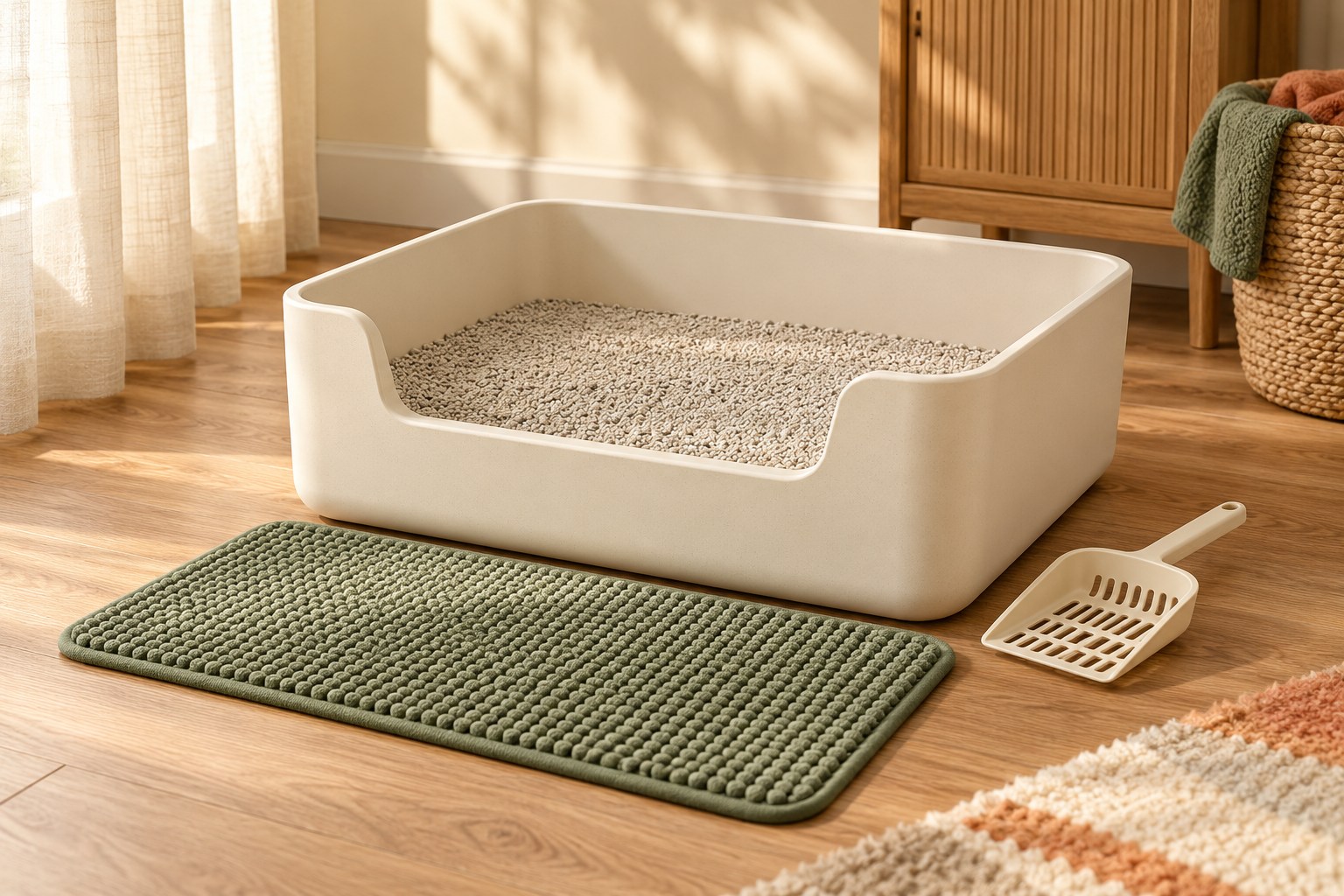
A covered litter box can conceal its contents from the room, but the cat experiences the interior rather than the exterior appearance. The lid reduces overhead space, changes sight lines, and may introduce a flap or narrow entrance. An open tray offers a different set of tradeoffs: easier observation and approach, with less containment of scattered litter.
Neither style is universally preferred. Compare the complete usable space and keep the cat’s actual response central to the decision.
Measure the interior, not the silhouette
Overall dimensions may include a projecting rim, filter housing, or sloping lid that does not provide usable standing room. Look at the floor area and overhead clearance where the cat turns. A large-looking hood can narrow sharply at the corners. A hypothetical long-bodied cat might fit through the door yet have to crouch throughout use. If the manufacturer gives only exterior measurements, ask for internal floor dimensions before treating the product as sufficiently roomy.
Examine the entry as a route
A doorway with a flap, lip, and short tunnel can create several obstacles in succession. Some cats use that arrangement comfortably; others hesitate. Consider whether the flap is optional according to the design and whether the opening remains smooth if removed. Keep the approach clear and avoid positioning the only entrance directly against a wall. In a multi-cat home, a single enclosed exit can also change how comfortable access feels when another cat is nearby.
Distinguish room appearance from interior conditions
A cover may reduce visible scatter without eliminating the need for prompt waste removal. Concealing odor from a person’s usual position does not establish that the interior is comfortable. Vent openings and filters need maintenance according to the product instructions, and replacement filters add an ongoing cost. Do not use a lid as a reason to postpone scooping. Compare how readily you can inspect the box every day without lifting a heavy awkward shell.
Test maintenance access before filling
Remove and refit the cover while the box is empty. Check clips, handles, and seams for places where litter or liquid can collect. A carry handle on a lid may not be intended to lift a filled box. Read the stated use before relying on it. A high rim can contain scatter but complicate reaching the corners with a scoop. Make sure the product can be maintained in your actual space without needing to move several other objects first.
Introduce changes with choice
When feasible, offer the new style alongside a familiar suitable box instead of removing the existing option immediately. Keep litter type and placement reasonably consistent so the enclosure is the main change being evaluated. Do not place the cat inside repeatedly to demonstrate how to use it. Observe voluntary entry, turning room, and whether the box is used normally. New avoidance, straining, frequent attempts, or other toileting changes warrant veterinary attention rather than repeated product swaps.
Choose for the household routine
A lightweight open tray may be straightforward in a spacious utility area, while a removable hood may help contain scatter in another location. The household’s visual preference matters only after usable space and access work for the cat. Keep essential resources appropriately distributed and follow veterinary or qualified behavior guidance when litter-box difficulties arise. A product can simplify maintenance, but it should not be expected to solve an unsuitable location or an underlying health concern.
Compare equal exterior footprints fairly
Imagine an open tray and a hooded box occupying roughly the same floor rectangle. The open tray has upright sides and nearly all its footprint available at litter level. The covered box has a thick rim, sloping roof, and an entrance tunnel projecting into the interior. Despite similar exterior size, the second may offer less turning room and a more complicated approach.
Now compare maintenance. The open tray can be inspected at a glance, while the hooded model needs its lid removed to see the rear corners. If the lid is awkward in the chosen location, the household may inspect it less often. That practical difference matters alongside the cat’s preference.
A useful trial keeps litter type and location as consistent as possible and preserves a suitable familiar option. Record the actual interior dimensions, entry behavior, and maintenance steps rather than ranking the designs by appearance. If a cover is removable and the maker permits lid-free use, that option may provide flexibility, but it should not be assumed to fix a floor area that is too small in the first place.

For our approach to product claims and illustrations, see the Editorial Policy.