
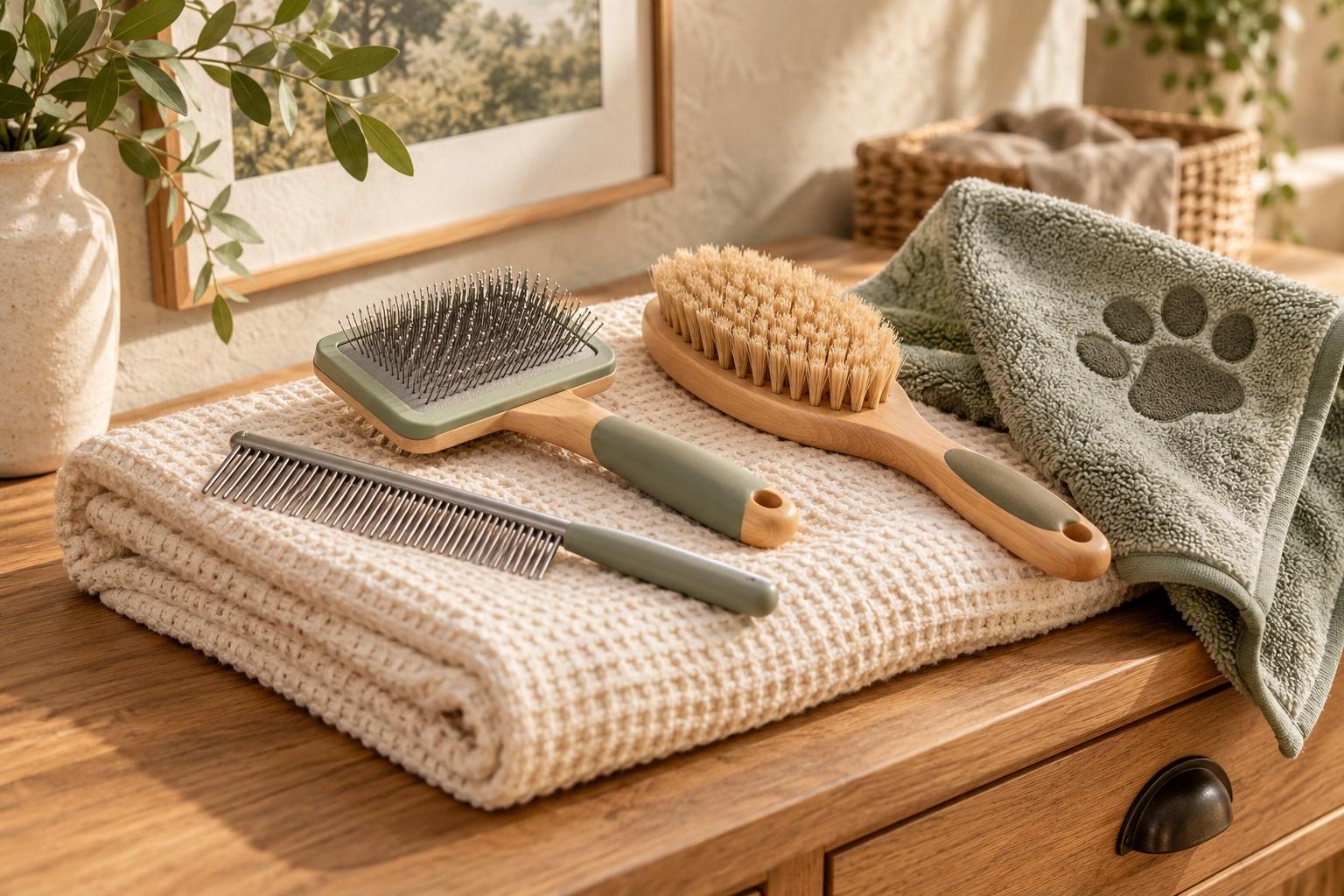
A pet towel has to work in an awkward setting: a moving animal, damp hands, and a floor that should remain clear. Microfiber products may offer a compact drying layer, but they vary in thickness and surface texture. The useful purchase is not necessarily the one promising the largest amount of water absorbed under unspecified conditions.
Size it for the handling routine
Measure the area you want the towel to cover without creating a long fabric tail under paws. A very large towel can wrap broadly but may be heavy and difficult to reposition when wet. A medium towel plus a second dry one can be easier to manage. Choose a size the handler can hold comfortably while keeping the pet on a stable surface.
Consider where the towel will be stored and washed. A large loop or hook can help it hang open to dry between appropriate cleanings, provided the loop stays away from the animal during use. A towel that only fits in a tightly packed cupboard while damp is poorly suited to the space. Practical drying area should influence the purchase alongside the advertised dimensions.
Compare pile and fabric body
Long soft pile feels different from a smooth dense microfiber surface. Longer fibers can hold hair and debris within the texture, while a flatter surface may be easier to inspect. Neither construction guarantees a particular drying performance without relevant information. Look for clear material composition and care instructions rather than relying entirely on the word microfiber, which covers a broad range of fabrics.
Weight affects handling. A very thin towel packs small but may need to be exchanged sooner during drying; a heavier one can become cumbersome when saturated. Where possible, compare products by both dimensions and listed weight. A towel with substantial decorative edging may feel bulky at exactly the point where the handler needs to fold and place it around a small contour.
Keep the edges simple
Examine hems, labels, and hanging loops for secure stitching. Loose threads can catch and are a reason to repair appropriately or remove a towel from use. Avoid long fringe or detachable decorative pieces. A simple bound edge is easier to inspect than an elaborate trim, and it generally leaves more of the towel as a flat usable drying surface.
Built-in hand pockets can improve grip for some handlers, but check whether they work from both sides and how easily they dry. Deep pockets add layers that may retain moisture. Use them only as intended and do not treat a towel as restraint equipment. If drying becomes difficult because the animal is distressed, adjust the handling routine or obtain guidance rather than wrapping more tightly.
Read the laundry instructions closely
Some microfiber towels have specific limits on softeners, heat, or other laundry products. Follow the actual label instead of applying a generic rule to every synthetic fabric. Remove loose hair as directed before washing and inspect the seams afterward. Dry the full towel, including pockets and thick hems, before folding it into a closed travel bag or cabinet.
Keep pet drying towels separate from tools that could snag the fabric. A metal comb or clipper packed in the same compartment can create damage that is not immediately obvious. For frequent use, two clearly identified towels in rotation may make maintenance easier than one oversized towel that never has time to dry. Replace worn material when its edges or surface no longer remain sound.
For our approach to product claims and illustrations, see the Editorial Policy.