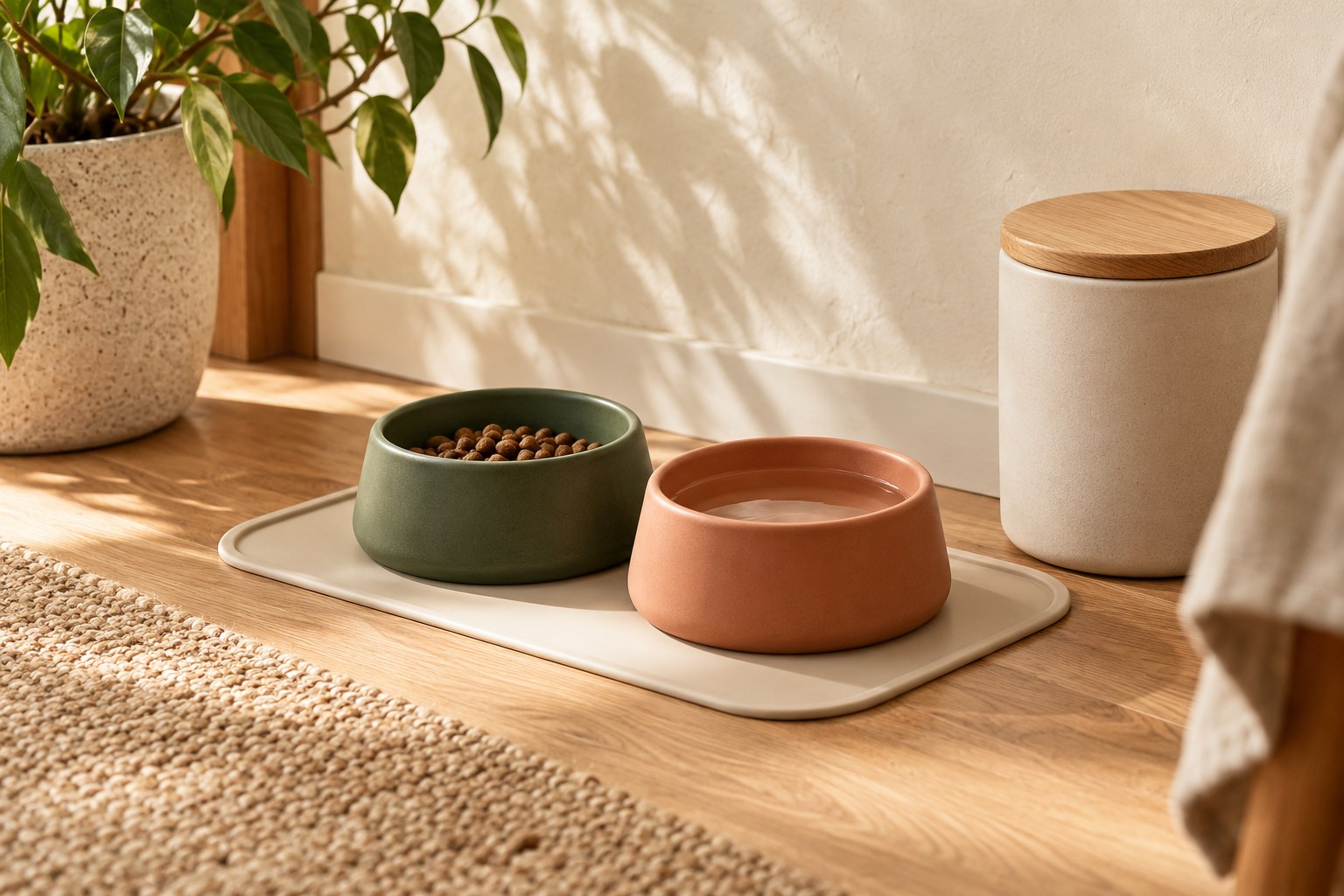
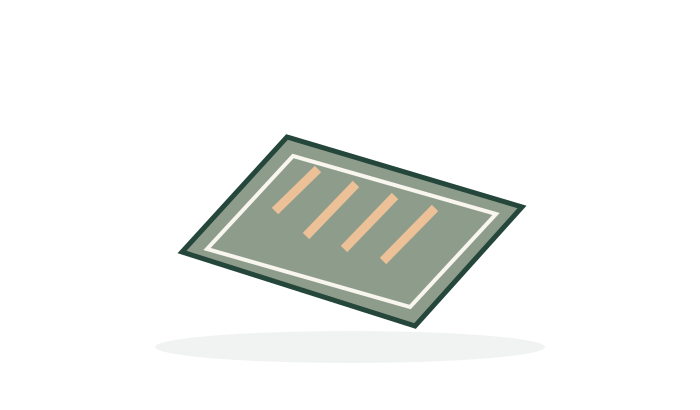
A lick mat spreads an appropriate food across a textured surface. The pattern changes how that food is reached and how much remains behind. Dense pockets can look impressive, but difficulty is not a quality measure by itself. Start with a design that allows an achievable interaction and a clear cleaning route.
Use only food already suitable for the individual pet and an amount consistent with its established feeding plan. The equipment does not make an unsuitable ingredient appropriate. Keep the session supervised, particularly when introducing a flexible mat that could be picked up and chewed.
Match texture to the food's behaviour
A smooth spread can sit across shallow grooves, while small pieces may lodge in deep corners. Look at the narrowest channel and the deepest pocket rather than judging the pattern as a whole. A mat with several zones may include one useful area and another that is difficult to access.
Try a small amount in an easy section first. The aim is to see how the animal interacts, not to cover every square centimetre. If the pet begins biting or pulling the mat, end the session and remove it rather than treating the behaviour as a sign that the challenge is working.
Compare flexible and rigid formats
A flexible mat can be bent for washing and storage, but it may also be easier for an animal to lift. A rigid backing can keep the surface flat while adding bulk. Neither format eliminates the need to supervise or inspect the product.
Check that the material is intended for food contact and that the manufacturer specifies how it may be used. Avoid assuming a craft texture sheet is interchangeable with a feeding product. Deep decorative impressions are useful only if they are reachable during both feeding and cleaning.
Start with less coverage
For a hypothetical first session, spread a thin patch across one broad-grooved corner. Observe whether the pet works over the surface calmly and leaves accessible traces or instead tries to detach the whole object. A small test provides clearer information than a heavily filled mat.
Gradually increasing the area gives you a way to compare engagement without immediately choosing a more restrictive pattern. Keep the mat within easy reach so you can remove it safely. Do not leave it as an unsupervised object once the food has been collected.
Plan where it will sit
A flat stable location helps prevent the mat from folding. Suction cups need a suitable surface and the product's intended mounting method. A cup that sticks to smooth tile may not attach to a textured floor, so check placement compatibility before buying.
Avoid using placement to create unnecessary difficulty. The animal should be able to approach without stretching over an obstacle or standing on a slippery surface. If a vertical mounting is supported, follow that model's instructions and test the attachment while you are present.
Decide by cleanup as well as use
Inspect the empty mat for inaccessible residue. A fine-textured design can require a dedicated brush, and a dishwasher claim does not eliminate the need to check the result. Dry the product according to its care instructions and inspect for tears before each use.
If food repeatedly remains in the same deep pocket, change the pattern or application method rather than adding increasingly elaborate cleaning tools. Accessibility is part of the design's value, not a compromise to be accepted after purchase.
Read mixed-zone mats as separate surfaces
A mat with ridges, dots, and deep honeycomb pockets is effectively several designs sharing one backing. Test each zone separately with a small amount before using the whole area. If broad ridges work and deep pockets retain food, you can choose a plainer replacement instead of assuming every zone must be used. Multi-pattern variety is valuable only when its individual sections remain accessible, appropriate, and practical to clean.
For our approach to product claims and illustrations, see the Editorial Policy.