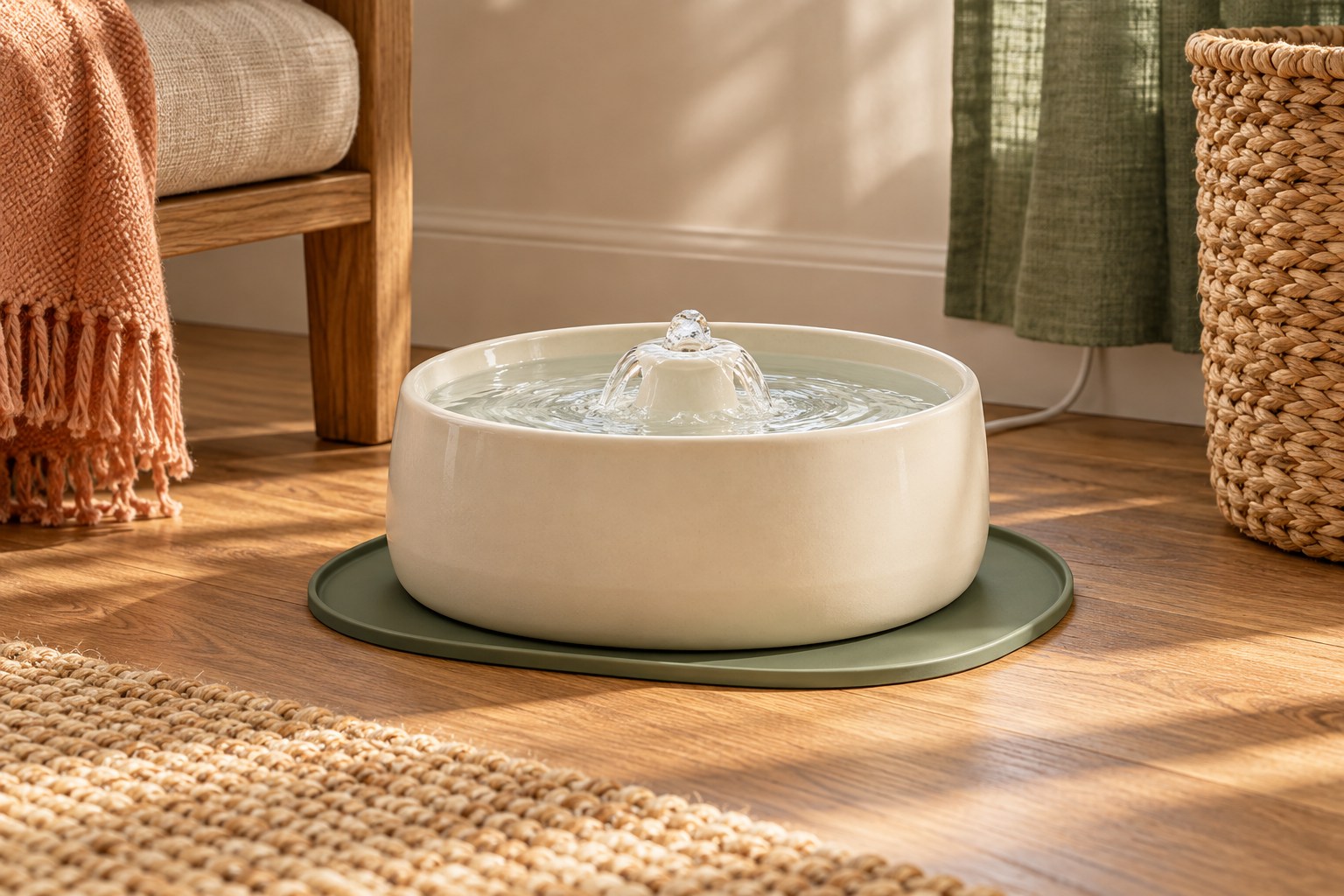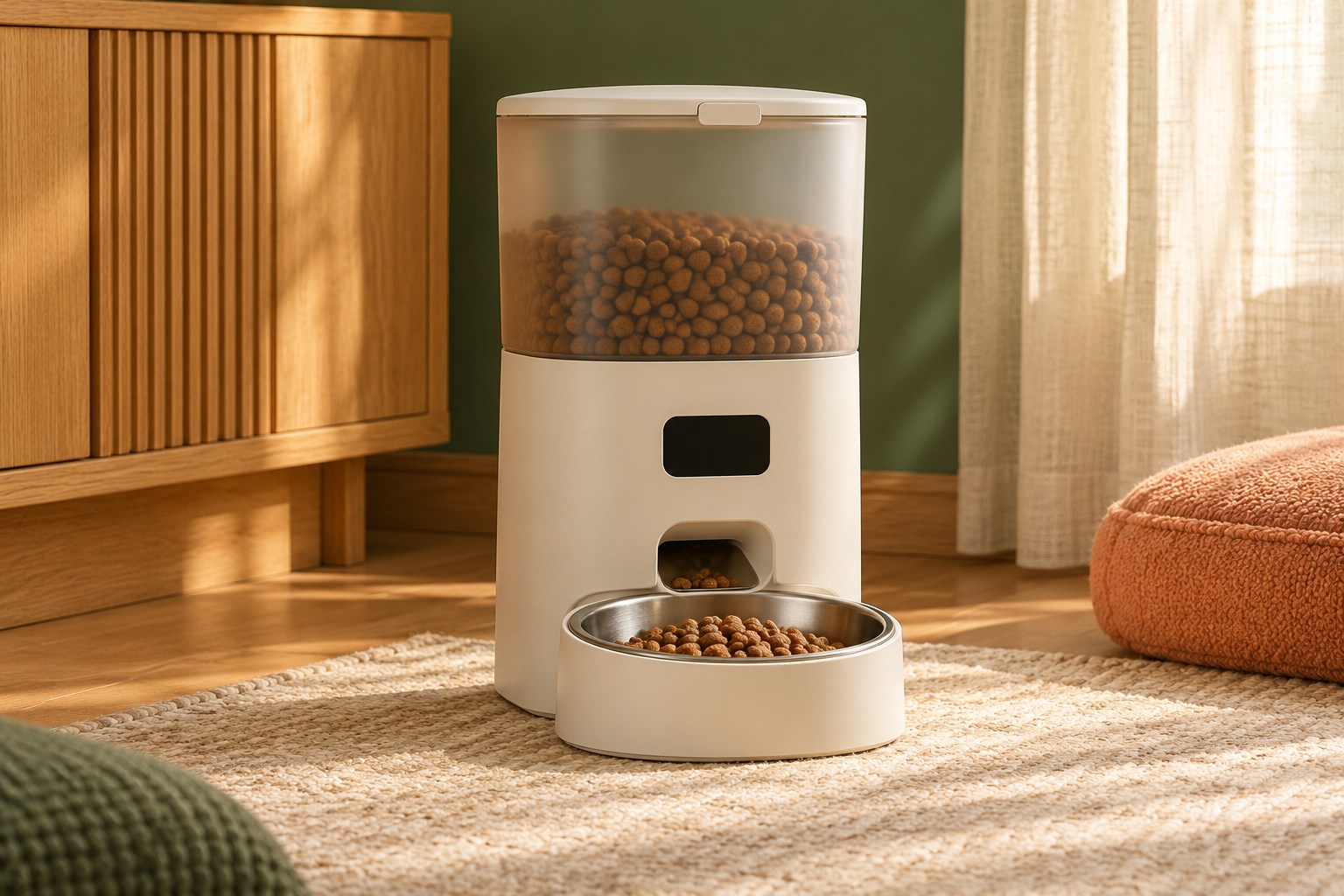
In a home with several pets, a feeder's reservoir capacity is only part of the purchase decision. The more important question may be which animal can reach the food and when. A machine can dispense perfectly while one pet consistently occupies the bowl.
Begin by observing separate supervised feeding opportunities. Record who approaches, who waits, and whether a narrow doorway or corner contributes to congestion. Equipment should support a workable arrangement rather than conceal access problems behind an automatic schedule.
Treat each eating position as a resource
A split outlet may look like two feeders, but closely spaced bowls can still be controlled by one animal. Measure the distance between eating positions and consider the space needed to approach and turn away. A shared hopper does not create separate access by itself.
Two stations in different locations can sometimes be easier to observe than a single large unit. Placement should suit the animals and household management plan. If you use doors or partitions, ensure the arrangement remains comfortable and appropriately supervised.
Understand identification systems precisely
Some products use a tag or implanted identification reader to open a cover. Check compatible identification formats, tag requirements, and how the lid behaves when another animal approaches. Do not assume that a recognised pet's access automatically prevents every other pet from reaching the bowl.
Study the opening size and side gaps. A lid can restrict top access yet leave room for another nose beside the intended user. Look for a documented training mode and a clear method for changing authorised identities when the household changes.
Introduce moving lids gradually
Allow the intended pet to explore the feeder using the maker's training process. A sudden moving cover or motor sound may require more time than a simple open bowl. Keep supervised access to food available while the animal learns the equipment.
Watch the whole sequence: approach, recognition, opening, eating, departure, and closing. A pet that triggers the reader but then steps away has not necessarily learned to use the station. Adjust within the instructions rather than increasing lid speed or defeating protective features.
Verify outcomes during ordinary use
Check each animal's access directly instead of relying solely on an empty bowl or app event. An empty bowl confirms food disappeared, not who ate it. If a camera is used, make sure the view shows the relevant approach and bowl rather than only the top of the hopper.
For a hypothetical two-cat household, separate stations may reveal that one location is used comfortably and the other is avoided. Moving the second station can be a more useful adjustment than buying a larger feeder. Continue appropriate human supervision, particularly while evaluating a new arrangement.
Compare identification with physical separation
An identity-controlled lid and a separately located open station solve different problems. The first controls a mechanism when a recognised animal approaches; the second changes the available space and observation. An identification feature may be useful, but its value depends on the opening geometry and how the animals behave around it. Test the complete approach sequence, not only whether the reader recognises a tag.
Suppose one pet comfortably opens the lid while another reaches alongside it. That result calls for reassessing the design or management arrangement rather than enrolling fewer identities and assuming access is now controlled. Where separate supervised feeding is the workable approach, choose bowls and locations that make it easy. A machine should support an established arrangement, not require the household to overlook repeated access failures.
For our approach to product claims and illustrations, see the Editorial Policy.