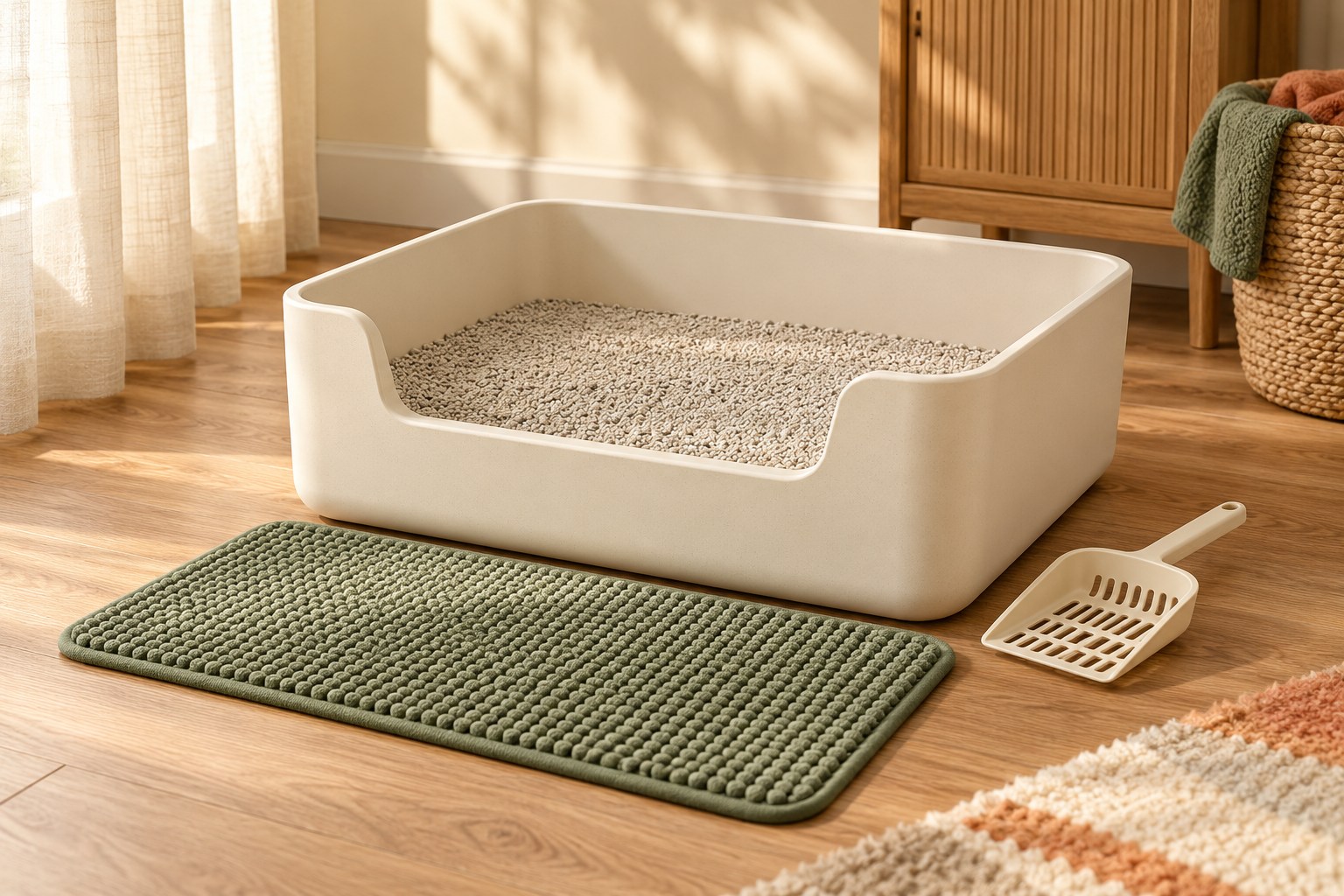
A litter mat sits directly on a route the cat must use. That makes texture and placement important: a product that captures granules well is not useful if the cat avoids stepping on it and takes an awkward route into the box. Deep honeycomb layers, soft ridges, and simple flat surfaces each offer different tradeoffs.
Choose the mat as part of the entrance arrangement, not as a separate promise of a litter-free floor.
Consider paw contact first
Feel the surface for stiff edges, rough ridges, and openings that could catch claws. Human touch cannot predict every cat’s preference, so allow a voluntary trial with a clear alternative route where practical. A hypothetical cat that jumps over a thick textured mat may scatter more litter on landing than it would while walking across a simpler surface. If avoidance appears, change the mat rather than forcing the cat to cross it to reach an essential resource.
Match openings to the litter
A double-layer design depends on granules passing through the top layer into the space below. Large pellets may remain on top; fine material may collect inside seams. Check compatibility with the litter you actually use and inspect how easily the layers separate. A broad mat can catch more footsteps but occupy more of the approach area. Size should accommodate ordinary departure without creating a raised obstacle in a narrow passage.
Check the base on your floor
A mat that slides as the cat steps can feel unpredictable. Test the backing on the actual flooring and follow any restrictions for delicate finishes. Thick edges can curl or create a trip point for people. Keep the mat flat and avoid layering several products to increase coverage. If the floor is uneven, a flexible mat may follow it better than a rigid tray, but it still needs to remain stable under ordinary movement.
Practice emptying before use
Open a layered mat and identify where collected litter exits. Some designs funnel neatly; others require lifting a large flexible sheet that spills from the sides. Decide where the material will go according to the litter maker’s guidance and local disposal rules. Do not automatically return debris to the box without considering contamination. A simple mat that empties predictably may fit the routine better than a high-capacity design that is awkward to handle in a small room.
Keep maintenance material-specific
Read washing and drying instructions, particularly for foam, rubber, and bonded layers. Moisture trapped between layers needs time to dry before the mat is replaced. Inspect for splits, exposed backing, and curled edges. If urine reaches the mat, assess whether the construction can be maintained adequately according to its instructions rather than assuming a quick wipe reaches every layer. Persistent toileting changes warrant veterinary attention and review of the entire box setup.
Evaluate the whole exit path
Place the mat where the cat naturally steps, with enough room to leave without landing on a chair leg or narrow doorway. A mat cannot capture litter that is kicked over a sidewall several feet away. Adjust box orientation or choose an appropriate containment design if that is the main issue. Review the amount of scatter alongside voluntary use; a somewhat simpler mat that the cat walks across comfortably may provide the more reliable practical result.
For our approach to product claims and illustrations, see the Editorial Policy.