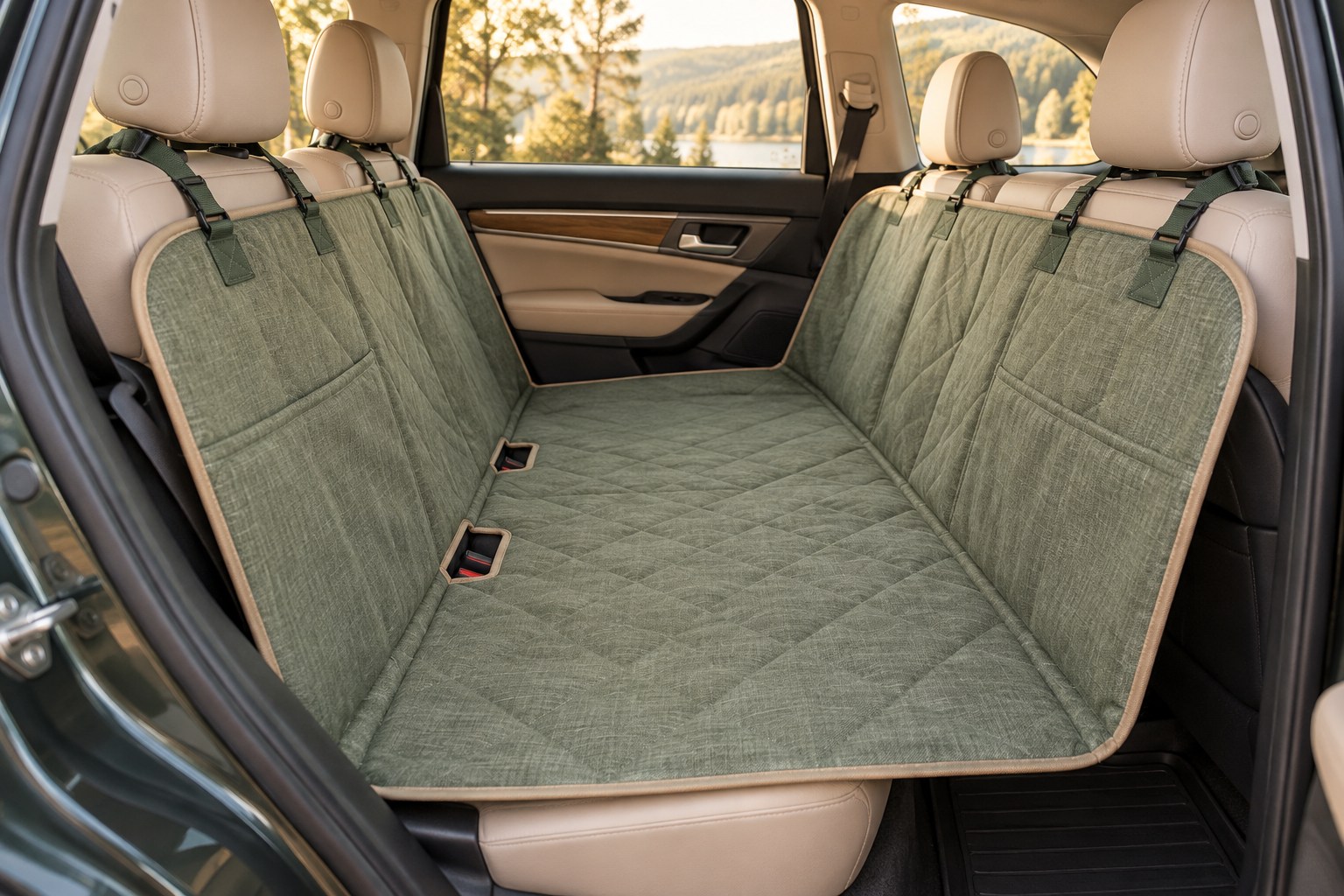
A bench liner offers a simpler alternative when a hammock's raised front panel is unnecessary or incompatible with the vehicle. It covers the seat and often the backrest while leaving the front open. Simplicity can make cleaning easier, but the liner still needs appropriate shape, secure ordinary positioning, and compatibility with the pet's actual transport arrangement.
Measure the seat as a shaped surface
Record bench width, seat depth, and backrest height. Include the contour around headrests and the way the seat meets door trim. A rectangular cover may leave side bolsters exposed or bunch where the seat slopes. Look for a diagram showing the coverage area rather than relying on a photo taken in a different car. The fabric should lie naturally without stretching around hardware.
If the rear seat folds or splits, decide which configuration will be used before buying. A full-width liner may need removal whenever one section folds. Split-compatible designs provide flexibility, but their zippers and seams add places for dirt and moisture to pass. Choose the configuration that reflects ordinary use rather than paying for every possible arrangement that the household rarely needs.
Preserve access to required equipment
Check belt slots against the car's actual buckle positions. A slit should allow correct routing without pressure, twisting, or hidden hardware. Follow the vehicle and pet-restraint instructions, including any restrictions on seat covers. Do not cut new openings casually; doing so may weaken the fabric and does not guarantee compatibility with equipment beneath it.
The liner does not restrain the animal, even if it includes a decorative lead attachment or a raised edge. Use a suitable travel system installed according to its exact instructions. If the cover prevents that installation, choose another liner or location rather than altering the restraint path. Comfort and upholstery protection are useful functions, but they should remain clearly separated from crash-performance claims.
Examine how it stays positioned
Backing texture, headrest straps, and seat anchors may help the liner remain in place during ordinary entry and movement. Check the maker's intended use and floor or upholstery compatibility. Some coatings can behave differently on leather, vinyl, or fabric, so read the seat's care guidance. A grippy surface should not leave residue or damage the finish underneath.
Watch for bunching at the front edge when the pet enters. Excess fabric can fold beneath paws or hang into the footwell. A snug shape may be more useful than simply choosing a larger cover. Any fastening tail should be secured as intended and kept out of doors and moving seat mechanisms. Do not improvise pins or adhesive attachment on vehicle upholstery.
Choose coverage around the real dirt
If most dirt arrives on the seat front, an extended flat flap can be helpful during loading when used as instructed. It should be positioned correctly before travel and must not interfere with doors or the pet's restraint. Side flaps protect different areas from a backrest panel, so decide which surfaces are actually exposed rather than assuming all covers offer the same protection.
For repeated damp outings, inspect water-resistance details at seams and buckle openings. A broad coated panel can still allow liquid through a stitched join. Remove the liner after significant spills and check the seat beneath. Layering several loose towels over it may increase sliding; a compatible removable pad is preferable only when it preserves fit and installation.
Reset the liner completely
Shake or remove loose debris where appropriate, clean according to the label, and dry straps and backing fully. Clean the seat beneath using the vehicle's instructions. Reinstall the liner carefully instead of assuming it will settle into position on its own. Check the transport restraint separately after every removal or major adjustment.
Inspect for torn slots, failed anchors, flaking backing, and loose seams. A worn liner may still look acceptable from the front while its underside has deteriorated. Keep dimensions and model information if the fit works well, but recheck compatibility when replacing it. Small construction changes can affect belt access even within a familiar product range.

For our approach to product claims and illustrations, see the Editorial Policy.