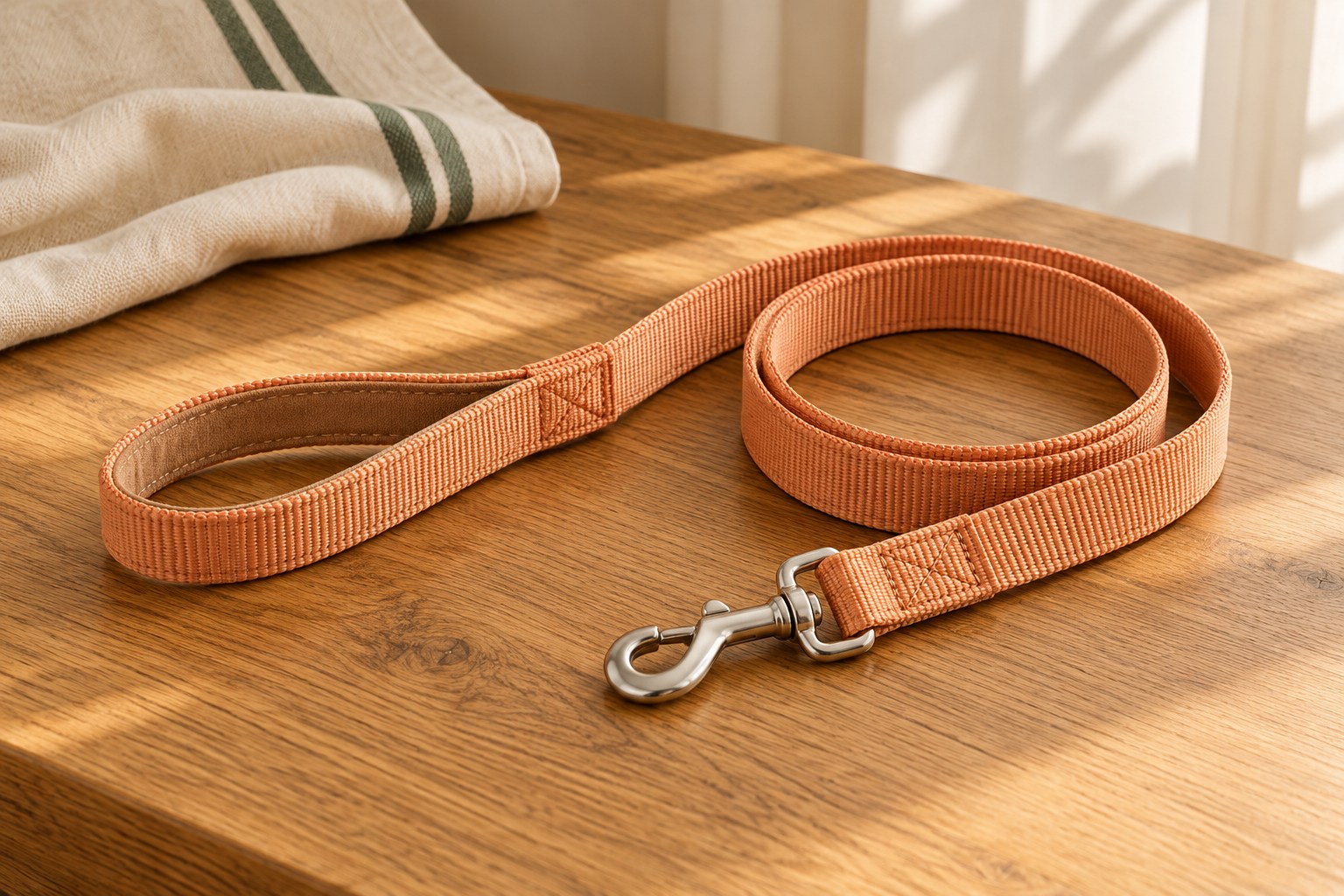
A lower handle is a second loop positioned near the dog end of a leash. It can make it quicker to gather distance at a crossing or narrow entrance. Yet a loop placed well for one dog and person may force another pair into an awkward posture. The useful feature is accessible shortening, not permanent tension.
Compare where the handle sits when your dog stands beside you with the harness correctly fitted.
Assess height before convenience
A person walking a tall dog may reach a low handle without bending. The same handle on a small dog may require stooping or lifting the leash sharply. Hold it briefly while the dog stands naturally and see whether the leash still contains a little slack. If the handle pulls the attachment upward just to reach your hand, its placement does not suit your combination. A regular leash gathered higher up may offer a more comfortable short connection.
Use the handle for defined moments
Prepare before entering a crowded area, crossing a road, or passing a narrow gate. Bring the dog alongside using practiced cues, then take the lower loop without jerking. Release back to the ordinary handle when there is space again. A hypothetical walk past an outdoor café may need a short interval of close positioning, followed by a wider verge for sniffing. Keeping the dog close for the entire route simply because a convenient second loop exists misses that distinction.
Look at the spare leash
When the lower handle is held, the upper section still needs a place to go. Gather it so it cannot fall around your feet or catch a bench corner. Padded loops may add bulk and extra seams, and a loop left dangling near the dog can snag vegetation. Check the design while the leash is loose as well as while it is shortened. Some handles lie flat; others stand open enough to catch a paw during a sudden turn.
Practice transitions without pressure
At home, move between handles several times while the dog remains relaxed. Avoid putting your hand through both loops in a way that prevents release or rearrangement. Check that clips and buckles remain clear of your fingers. A lower handle is not a lifting point, and pulling upward through it should not substitute for teaching a comfortable close position. If you frequently need both hands to organize the leash, reducing accessories on the handle may help more than adding another feature.
Test the handle during a real pause
In a secure quiet place, stand as you would while waiting at a crossing and invite the dog beside you. Take the lower handle without bending toward the road or lifting the harness. Check whether the dog can sit and lower its head slightly while a little slack remains. Then return to the upper handle and walk away smoothly. The transition should not require threading a hand through several loops or stepping over spare material.
A hypothetical tall handler with a very small dog may find that no low handle position is comfortable. In that case, gathering a conventional leash at a higher point can achieve the same practical shortening without forcing a posture. Another pair may find a lower loop useful only over a thick winter coat because their arm position changes. Test with the clothing and equipment you actually use.
Keep the handle’s purpose narrow: a brief organized connection in limited space. It does not replace training a close position or justify keeping the leash taut through the entire walk. If the extra loop catches vegetation during relaxed movement, its occasional convenience may not outweigh the daily nuisance.
For our approach to product claims and illustrations, see the Editorial Policy.