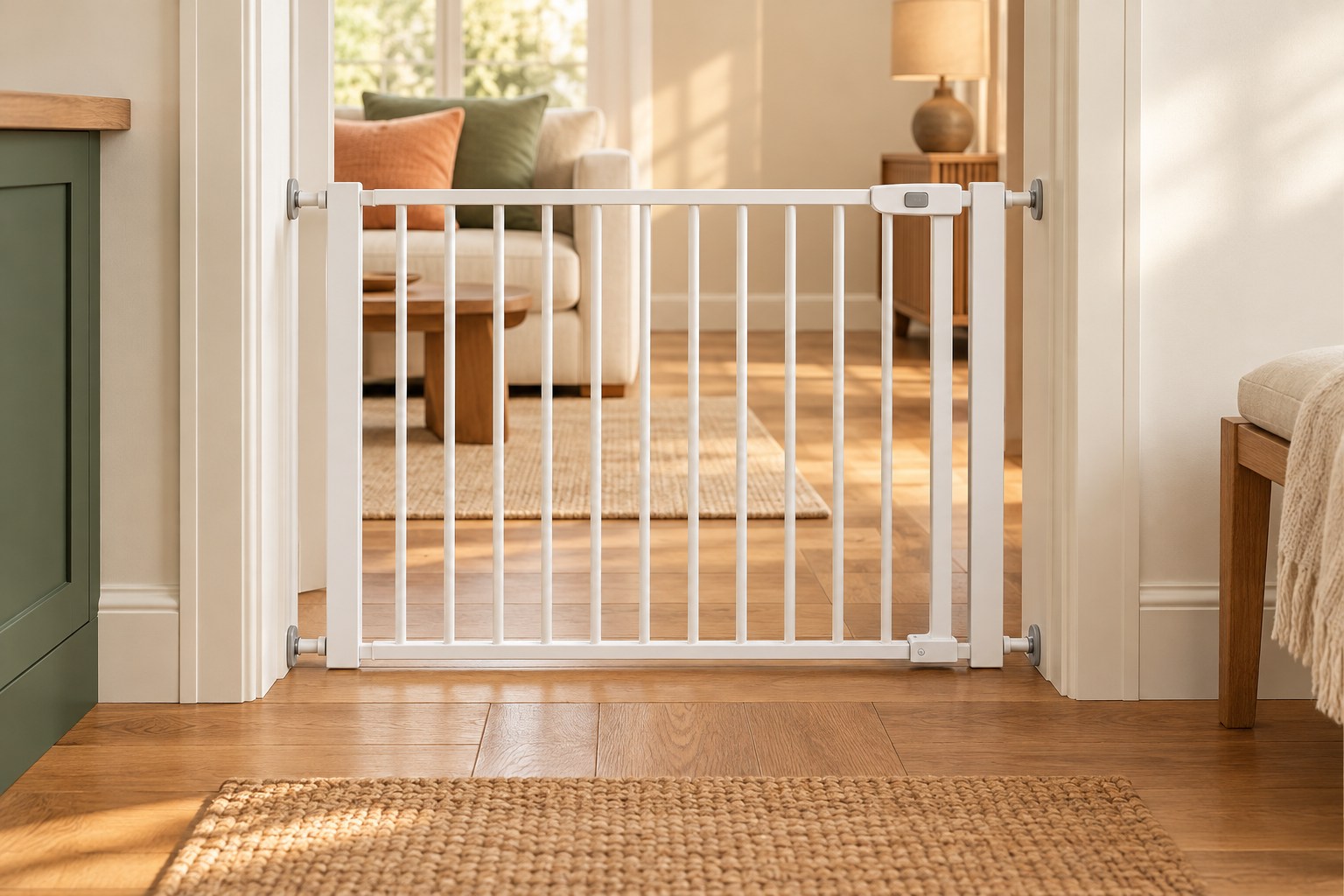
A pressure-mounted gate can divide some indoor spaces without the same installation as a wall-fastened design. That convenience depends on the opening providing suitable contact and the gate being used exactly as intended. Start with the doorway and the pet's likely behavior. A removable format should not be selected simply because it avoids drilling in a location that requires a different safety approach.
Measure more than one width
Measure the opening near the floor, at the intended upper contact height, and at any point affected by trim. Baseboards and uneven jambs can change where the gate presses. Compare the product's permitted opening range and extension combinations with those actual measurements. A listing's maximum width may require specific additional parts rather than the gate alone.
Look at the contact surfaces themselves. Rounded trim, fragile finishes, and uneven walls may be incompatible with the intended mounting cups or pads. Read both the gate instructions and relevant surface-care guidance. Do not add arbitrary blocks or stacked pads to make a poor fit seem tight. A compatible installation uses the specified parts on suitable surfaces, not a creative accumulation of shims.
Consider the location's consequences
A gate at a quiet room entrance serves a different purpose from a barrier near stairs or a drop. Choose a product explicitly appropriate to the exact location and follow its installation requirements. Do not use a pressure-mounted gate at the top of stairs. A pet gate also should not be assumed suitable for child safety; products and standards for those roles need separate assessment.
Think about what happens if the gate moves or opens. If failure would expose the pet to a serious hazard, a more secure separation plan may be needed. A gate is not a complete substitute for a closed door, supervision, or an appropriate containment arrangement. Jumping, climbing, and pushing behavior can make a product unsuitable even when the doorway dimensions appear correct.
Read the threshold and doorway details
Many walk-through gates include a lower bar across the opening. That threshold changes how people and pets cross the doorway when the gate is open. Consider the household's mobility and the traffic level. A very narrow walk-through opening can become inconvenient when carrying laundry or cleaning equipment, encouraging people to step over the gate rather than use it as intended.
Gate swing direction also matters. Check whether the door can strike furniture or be left projecting into a walkway. An auto-close feature needs to function in the actual setup, not just in an empty product demonstration. Confirm the latch engages after ordinary passage and do not assume that a soft closing sound means it is secured. Every household member should understand the same operating method.
Match spacing and height to the animal
Bar spacing should be appropriate for the pet's body and head size, and the overall height should reflect the intended use. A small opening marketed as a cat door may also admit another animal or create a place to investigate. Do not assume that a taller gate solves climbing or jumping. Behavior needs assessment alongside dimensions, and difficult containment may call for qualified guidance.
Inspect the working area for collars, tags, or household objects that could catch. Keep nearby furniture from becoming an easy launch point if that would undermine the separation. Introduce the gate under supervision and observe how the pet responds. Persistent attempts to force or climb it are reasons to revise the setup rather than tighten beyond the manufacturer's instructions.
Recheck after installation
Pressure settings can change through ordinary use, so follow the maker's inspection and adjustment schedule. Check contact points, latch alignment, extensions, and any signs of movement. Reassess after the gate is struck, removed, or relocated. A gate moved to a different doorway needs a new compatibility check rather than the old settings carried over.
Clean contact pads and working parts as instructed and inspect finishes for damage. Keep installation instructions and part information available. If a piece is missing or cracked, stop using the gate until an appropriate replacement is fitted. The convenience of removal is worthwhile only when the gate returns to a sound verified setup each time it is reinstalled.
For our approach to product claims and illustrations, see the Editorial Policy.