
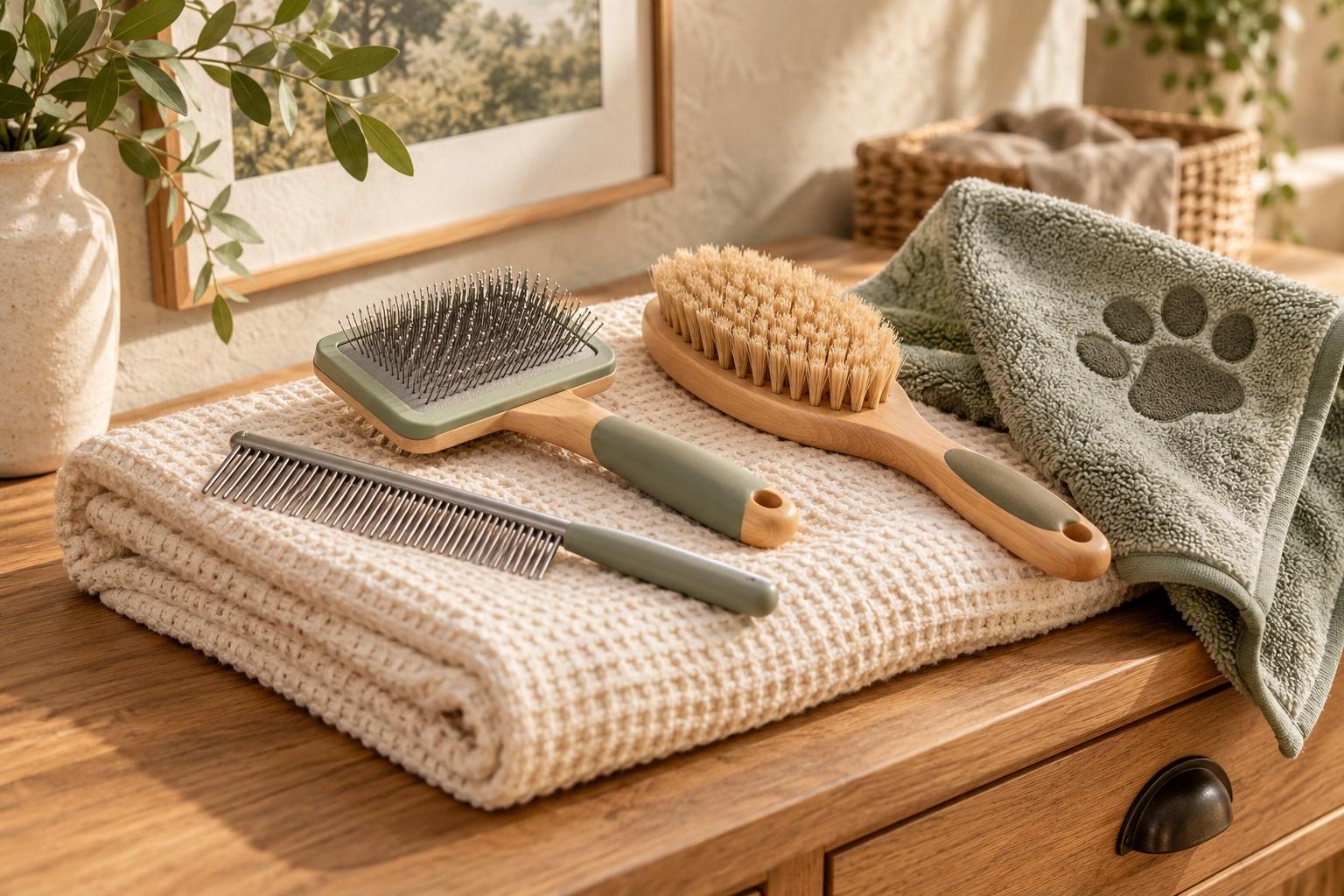
A pin brush usually has fewer, more widely spaced pins than a slicker, often set into a flexible cushion. It can be a useful part of routine care for some longer coats, but the category is broad. A brush with long metal pins and a deep cushion behaves differently from a compact tool with short capped pins.
See how the pins are supported
The cushion controls how much the pins move under ordinary light contact. A very rigid mounting offers a different feel from a flexible pad, so check the actual construction rather than assuming every cushioned brush is equally gentle. Inspect the pins for even placement and sound tips. Missing caps, rough ends, and loose pins are reasons to stop using a worn tool.
Some cushions include an intentional air opening. Do not mistake that feature for a missing pin without checking the product instructions. Equally, do not dismiss a genuine gap or tear as normal construction. Photographs of the original brush can help when assessing wear later. A replaceable pad is useful only if the maker actually sells one compatible with the head you own.
Match reach to the coat without forcing it
Pin length should suit the intended coat-care task, and a qualified groomer can help identify the appropriate reach. A brush that glides over the visible surface does not necessarily show that the entire coat is free of tangles. Conversely, choosing the longest pins available can create poor control on a small animal. More reach is a feature to use deliberately, not a universal upgrade.
If the brush catches repeatedly, stop rather than dragging it through. Dense mats and unfamiliar coat problems need professional guidance. Avoid trying to solve every snag with a different forceful tool. The aim is manageable routine maintenance, and product selection should sit within a suitable grooming approach rather than replace instruction on pressure, coat sections, and the pet's comfort.
Choose a head you can place accurately
An oval head has rounded edges that can be easier to maneuver than a broad square frame in some areas. A narrow head reaches smaller zones but takes longer across a large surface. Compare the usable pin area with the overall housing: a bulky border adds size without adding working reach. Look for a balanced connection between head and handle so the brush does not twist in the hand.
For households with more than one handler, check grip comfort across hands. A handle that suits one person may force another to pinch awkwardly. Grippy material can be helpful when clean and dry, but deep texture may collect hair. A simple wipeable handle and a well-shaped grip can be more practical than elaborate rubber fins that become difficult to inspect.
Keep the cushion clean and dry
Remove collected hair gently so it does not pull pins out of alignment. Follow the maker's instructions for washing or wiping; not every cushioned tool should be immersed. Let any permitted moisture dry fully before storage. A closed case is convenient for carrying a clean dry brush, but it can conceal dampness if the tool is put away immediately after cleaning.
Store pin brushes away from heavy clippers and metal combs that could bend their working parts. Inspect the cushion for splits and the handle joint for movement. A tool that feels loose can change angle unexpectedly during use. Keeping a small care record is unnecessary for most households, but retaining the product name helps when replacing a brush that proved well matched.
For our approach to product claims and illustrations, see the Editorial Policy.