
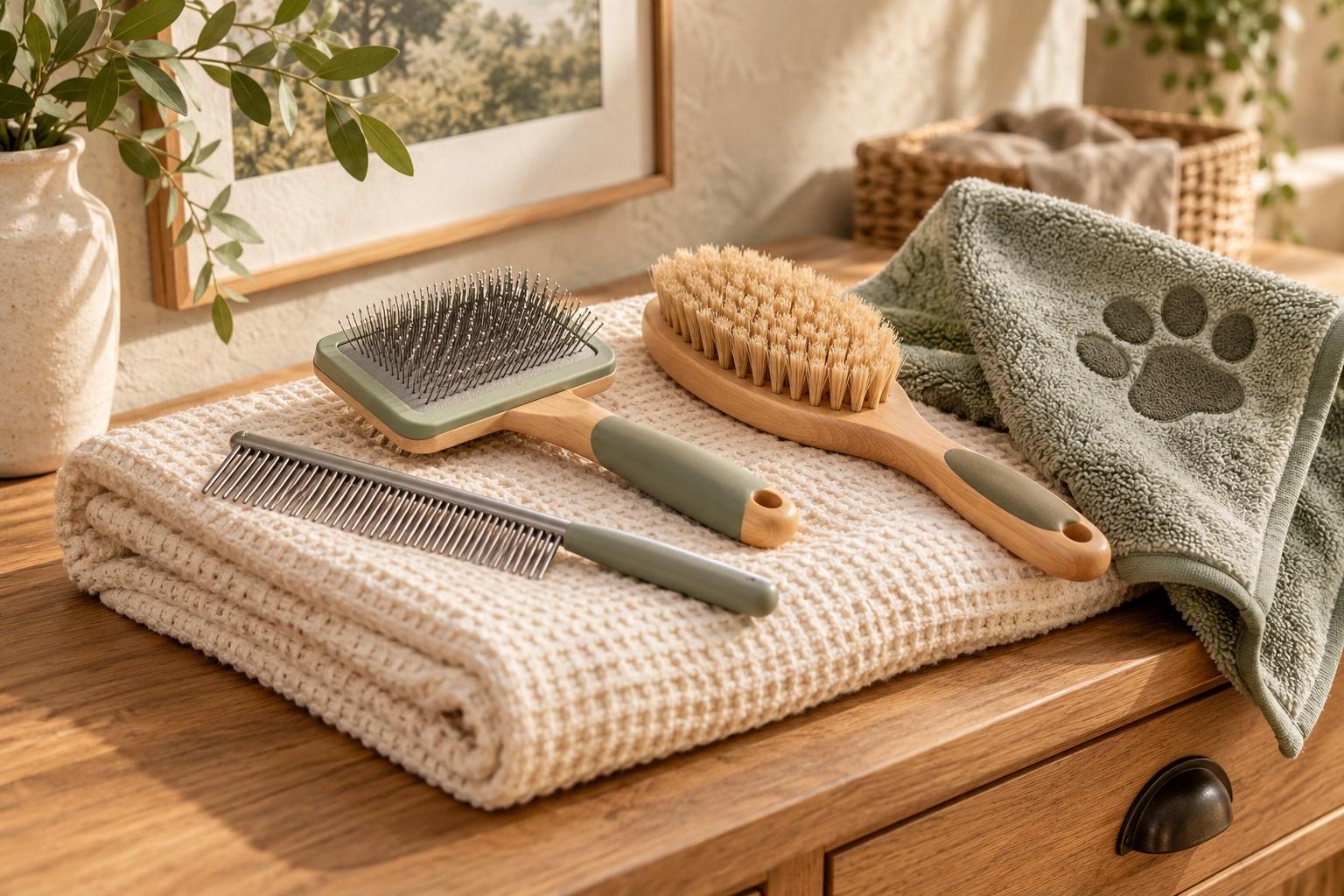
A towel with hand pockets aims to connect fabric more securely to the handler's hands. That can be helpful when an ordinary towel repeatedly slips during gentle drying. It also adds layers and seams, so the format should be evaluated as a handling tool rather than assumed to be an automatic improvement over a plain rectangle.
Check the hand position
Pocket spacing should suit the person's reach without pulling the towel tight across the animal. If the pockets are too far apart, the handler may lose the flexibility needed to reposition the fabric. If they are very close, much of the towel can hang unused. Look for photographs that show actual pocket dimensions and orientation rather than only the product folded neatly.
Try to imagine putting hands into the pockets while the towel is damp. Tight openings may be difficult with larger hands, while very loose pockets may not improve grip. A mitten with finger divisions can feel precise but may fit fewer people. For a shared household, simple generous pockets may be more adaptable than a highly fitted hand shape.
Understand what the towel is for
The purpose is to hold a drying surface, not to immobilize the pet. Use gentle contact within a suitable drying routine and leave room to stop if the animal becomes uncomfortable. Avoid wrapping so tightly that the pet cannot move normally. If handling is persistently difficult, ask a qualified groomer or veterinarian for guidance appropriate to the animal rather than choosing a more restrictive fabric format.
An example helps clarify the purchase: a small towel with two pockets may work well for controlled blotting after an ordinary wash, while a long outdoor drying session may require an additional dry towel. Buying a giant pocketed product does not solve every situation. Consider the sequence of use and whether a plain backup would keep the routine simpler.
Inspect the extra seams
Pocket corners take repeated pulling when hands enter and move. Look for consistent stitching and securely finished edges. A loose corner can grow into a larger opening, and decorative loops add unnecessary places to catch. Check the reverse side because pocket seams may form a thicker ridge against the animal. Flat construction can make the towel easier to reposition comfortably.
Some mitts have elastic cuffs. These should be comfortable for the handler and easy to remove promptly, not tight enough to make releasing the tool awkward. Read whether the cuffs use materials with different care requirements. Elastic that becomes brittle or loose changes the fit even when the drying fabric looks intact. Replace a damaged mitt rather than continuing with a cuff that sheds fragments.
Plan the drying and storage
Pockets and cuffs can remain damp after the main panel feels dry. Hang or arrange the towel according to its instructions so air reaches those areas, and inspect them before folding. Do not stuff a used mitt into a closed grooming bag to deal with later. A separate washable transport pouch may contain damp items temporarily, but the towel still needs prompt proper cleaning and drying.
Wash according to the fabric label and check that pocket openings do not turn into tight bundles during the cycle. After drying, inspect seams and return the towel to a dedicated clean place. If the format is repeatedly slow to dry in your home, a plain towel may be more practical. Handling convenience should be judged across the full routine, including the work after the pet is dry.

For our approach to product claims and illustrations, see the Editorial Policy.