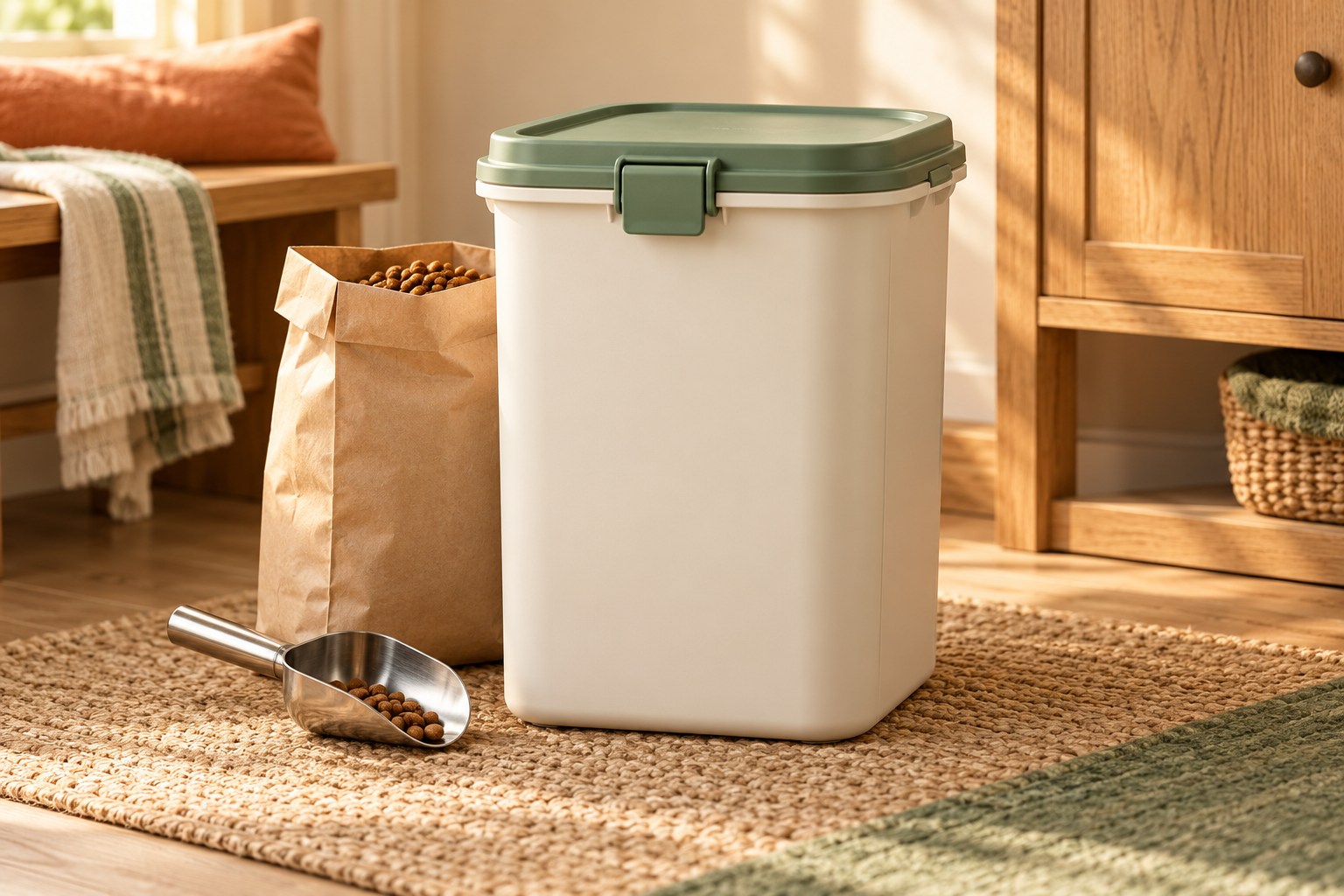
A scoop turns a deep storage bag into an easier daily task. Its broad mouth can move food neatly, while a long handle reaches the bottom of a container. Those conveniences do not make every scoop a precise measure. A heaped scoop and a level scoop can hold noticeably different amounts.
Keep the intended serving amount separate from the scoop's appearance. Use the feeding guidance already appropriate for your pet, then determine how your chosen tool relates to that amount. This guide concerns repeatable handling, not deciding a diet.
Read the markings carefully
Some scoop markings describe a volume, while others are merely decorative increments. Check the stated unit and whether the line refers to the inside or outside edge. A moulded line can become difficult to see when the scoop contains food.
Volume alone also does not establish the weight of every food. Different shapes settle with different gaps between pieces. If your serving method uses weight, use a suitable scale rather than treating a cup marking as a universal conversion.
Compare the mouth and handle
A broad mouth collects food quickly but may spill when it passes through a small feeder opening. A narrower front can pour more neatly. Test the path from bag to bowl, including any cupboard shelf that restricts the angle of your wrist.
Handles need enough length to keep fingers out of the food, but excessive length can prevent the storage lid from closing. A comfortable scoop outside the container may be more useful than one that must be buried diagonally in every bag. Keep its storage location clean and dry.
Establish one filling method
For a level measure, decide how the top will be levelled without crushing or packing the food. Repeatedly shaking the scoop can change how pieces settle. Compare several servings using the same method to see how consistent the result is.
For example, if a hypothetical level scoop repeatedly lands near 42 grams but occasional heaps reach 55 grams, the method is the source of variation. A written note stating level scoop is clearer than a note saying one scoop. Use a scale when greater precision is required by your established feeding plan.
Make washing and storage practical
Choose a smooth interior without inaccessible handle cavities or deeply embossed decorations. Follow the product's washing instructions, then dry it completely before returning it to the storage area. A wet scoop should not be put back into dry food.
If several products are stored nearby, label the scoop's intended use and serving method clearly. Avoid assuming that similar-looking scoops hold the same volume. When replacing a damaged tool, repeat the measuring check instead of transferring the old instructions to a different shape.
For our approach to product claims and illustrations, see the Editorial Policy.