High litter-box walls can contain some scattered material, but raising every edge also raises the effort needed to get inside. A low entrance with taller surrounding sides tries to balance access and containment. The result depends on the doorway shape, the cat’s movement, and whether the remaining interior provides enough room.
Choose the access route first, especially for a cat with mobility changes, and discuss new difficulty with a veterinarian.
Inspect the doorway profile
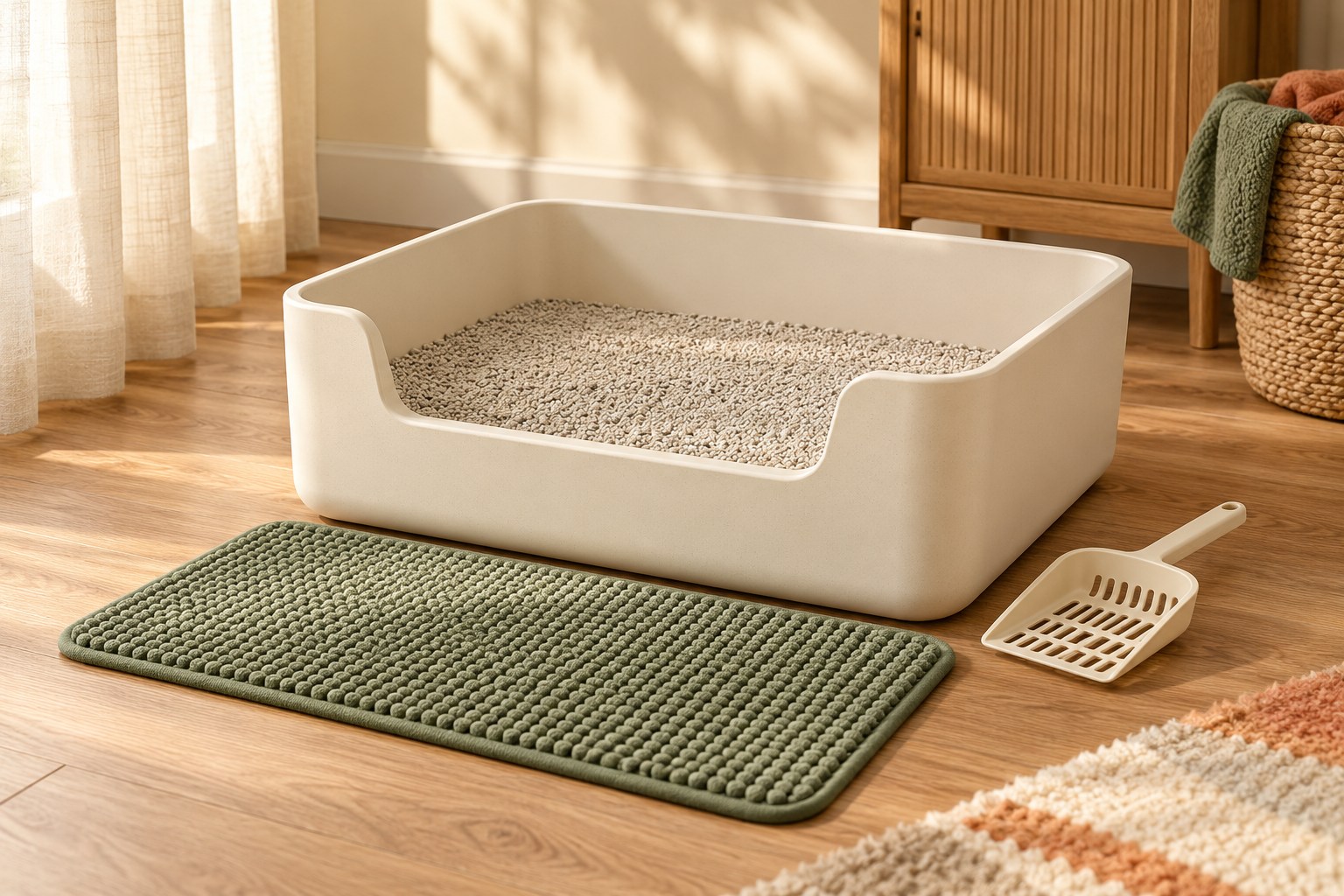
A low cutout is most useful when its lower edge is smooth and its width allows an ordinary step. A narrow notch can force a sideways squeeze even if the lip is low. Check the height from the floor outside and from the litter surface inside, since those are different steps. A hypothetical box with a thick raised base may have a surprisingly high entrance despite a low-looking front panel. Compare actual measurements rather than a front-view photograph.
Keep containment claims realistic
Taller sides may intercept litter kicked toward the walls, but material can still leave through the entrance or on paws. The low opening is intentionally the least contained point. Position a suitable mat outside without blocking approach, and avoid facing the entrance toward a narrow household walkway. Do not overfill the box merely to reduce the step down inside; follow the litter and box guidance because fill depth changes both containment and maintenance.
Check floor shape and turning room
Some high-sided designs taper sharply toward a small base. Their broad upper rim can make the box look larger than its usable floor. Compare internal dimensions at the litter level, including rounded corners or internal projections. The cat should have room to enter, turn, and position itself without crowding the walls. If a larger box cannot fit the chosen location, reconsider the location rather than assuming a high-sided small box offers equivalent usable space.
Look for awkward joins
A removable upper wall can simplify transport or maintenance, but the seam may collect material or allow leakage depending on construction. Inspect clips and ensure the upper section seats fully. Integrated smooth walls reduce joins but can be bulkier to handle. Try reaching all corners with the intended scoop before filling. If a wall must be removed every time, make sure the process is manageable enough that it will not discourage the daily routine.
Account for the cat’s approach
A low entrance should remain visible and unobstructed. Avoid placing it behind a swinging door or at the end of a narrow dead-end passage where another animal can wait. If the cat steps over a high side instead of using the entrance, observe whether the doorway faces an inconvenient direction. Changing orientation may solve an access issue without changing the whole box. Keep a familiar suitable alternative available during a transition when space permits.
Evaluate after ordinary use
Note where litter escapes and how the cat enters and leaves. A small amount of scatter near the low opening may be an acceptable tradeoff for easier access. Repeated reluctance, altered posture, or new toileting changes need investigation, with veterinary advice where appropriate. Inspect edges and clips as the plastic ages, and replace a cracked wall rather than leaving a sharp boundary. Choose the design that preserves comfortable access, not the one that promises a perfectly clean perimeter.
Work through a containment-access comparison
Consider two boxes with similar internal floor areas. One has uniformly high walls; the other has the same side height with a broad lower doorway. A cat that uses the doorway can enter with less climbing, but litter may leave through that opening during digging. A stable mat in the natural exit path may address part of the scatter without sacrificing the easier entrance.
If the cat repeatedly jumps over a high side instead, inspect the doorway orientation. It may face a wall, a busy passage, or another animal’s favored position. Turning the box can be more informative than buying a higher front wall. Observe the route without repeatedly repositioning the cat.
The tradeoff should remain visible in the purchase decision: complete scatter containment and easy low entry are not the same goal. Choose an acceptable amount of maintenance around an entrance the cat uses comfortably. If new mobility difficulty is involved, ask a veterinarian about suitable access before trying to make the cat adapt to a more demanding barrier.
Keep the entry measurement in your notes when comparing replacements. A model with similar overall height may have a much narrower cutout. Preserving an entrance that already works can be more valuable than gaining a small amount of additional wall coverage.

For our approach to product claims and illustrations, see the Editorial Policy.