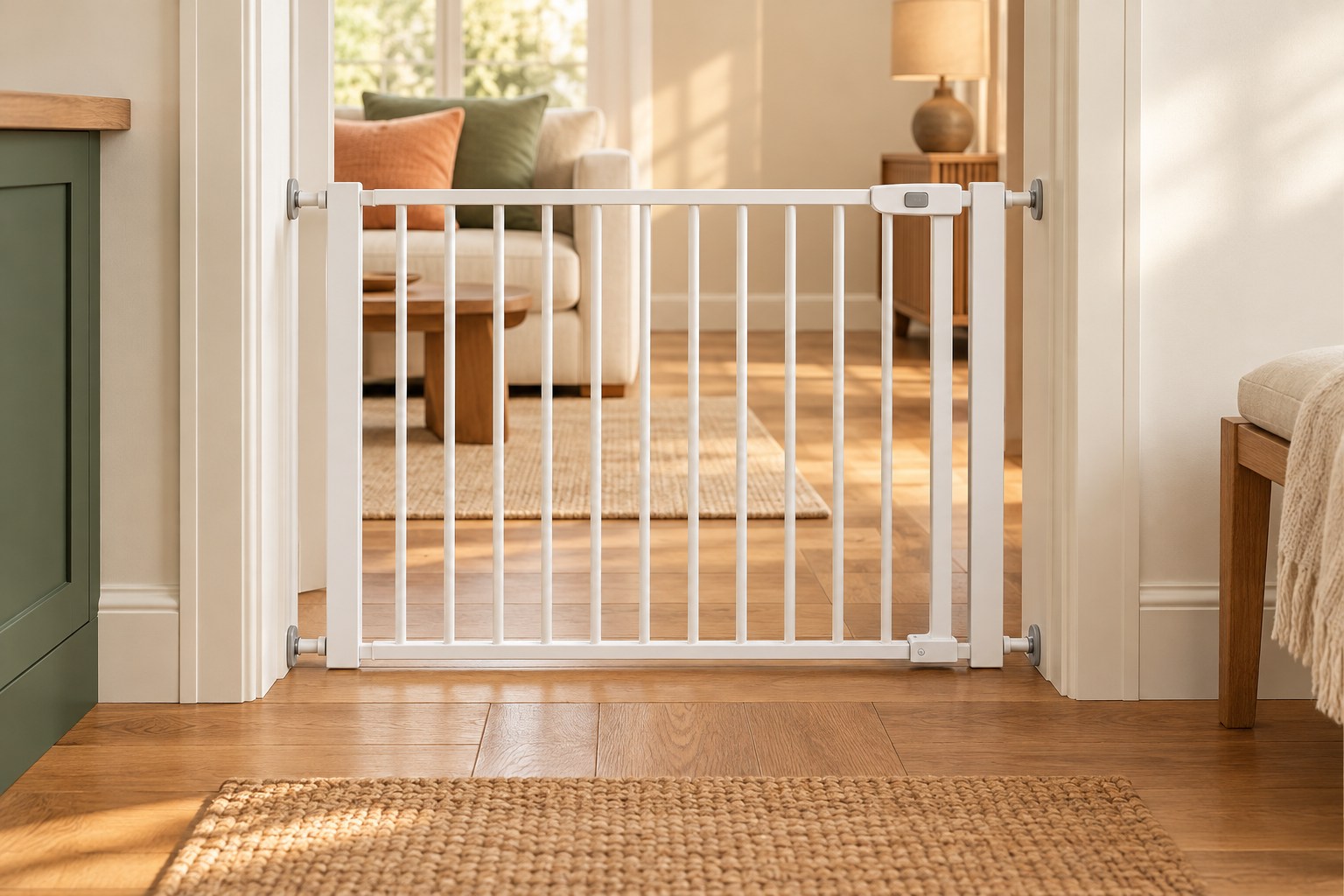
A hardware-mounted gate can create a more permanent room boundary, but fastening a gate to a wall is not the same as fastening it securely. The product needs compatible structure, specified hardware, and enough room to swing and latch correctly. Plan the entire doorway before drilling so the final setup serves the pet and the people who use the space.
Identify the supporting structure
Read the installation instructions to determine which surfaces and fasteners are permitted. Drywall, wood trim, masonry, and hollow panels do not behave identically. A decorative molding may look substantial while offering little suitable support. If the structure is uncertain, obtain competent installation advice rather than choosing a larger screw and hoping it solves the issue.
Use the specified mounting arrangement and approved accessories. Uneven baseboards may require a manufacturer-designed adapter, but an improvised stack of wood blocks can change alignment and loading. Check for household utilities before drilling and follow appropriate installation practice. The goal is a correctly supported gate, not simply a bracket that appears flush in a photograph.
Plan the opening arc
Mark the door's full swing on the floor using removable tape. Include nearby furniture, doors, radiators, and storage. A gate that opens cleanly while the room is empty may become awkward when a laundry basket or chair is in its usual place. Check the maker's restrictions on swing direction for the specific location, particularly around stairs or level changes.
Measure the usable passage width when the gate is open. A narrow access point may frustrate daily movement even if the overall barrier fits the wall opening. Some designs offer little or no floor threshold, while others retain a lower structural member. Consider the household's mobility and cleaning routine before assuming that a particular gate format will be convenient.
Choose the barrier for the pet
Height and bar spacing must suit the intended animal and use. A gate does not become appropriate for a climbing or jumping pet merely because it is wall-mounted. Nearby furniture can change how the animal interacts with it, and a small access door may be usable by more pets than expected. Observe the actual behavior under supervision before relying on the arrangement.
Keep product roles clear. A pet gate should not automatically be used as a child-safety gate, and a decorative room divider is not equivalent to an appropriate fixed barrier. For high-consequence locations, select a product explicitly intended for that setting and follow all requirements. If no compatible installation is available, use another suitable separation method instead of improvising around a hazard.
Test the latch as everyday hardware
After correct installation, check the empty gate's movement and latch engagement according to the instructions. The door should not scrape, bind, or need to be lifted into place unless that is its intended operating method. Misalignment can indicate an installation problem rather than a tight new mechanism. Resolve it before the animal begins using the divided space.
Make sure all household members can operate the latch and recognize when it is secured. A complicated release can be appropriate for a design purpose but may lead people to leave the gate open if it is inconvenient. Auto-close features still need inspection. Do not rely on the sound of closure or the door's apparent position as the sole sign that the latch has engaged.
Maintain the mounting points
Follow the maker's inspection schedule for brackets, fasteners, hinges, and latch alignment. Recheck after significant contact or changes to the surrounding structure. A wall repair or new floor layer can affect an installation that previously worked. Keep pets away during maintenance and remove the gate from use if its supporting parts are loose or damaged.
Clean according to the materials and avoid letting residue collect in the latch. Retain the exact model and installation instructions for replacement parts. If the gate is removed, store all hardware together and reassess the structure before reinstalling it elsewhere. A fixed gate is a useful household tool when its permanence is matched by an equally deliberate inspection routine.

For our approach to product claims and illustrations, see the Editorial Policy.