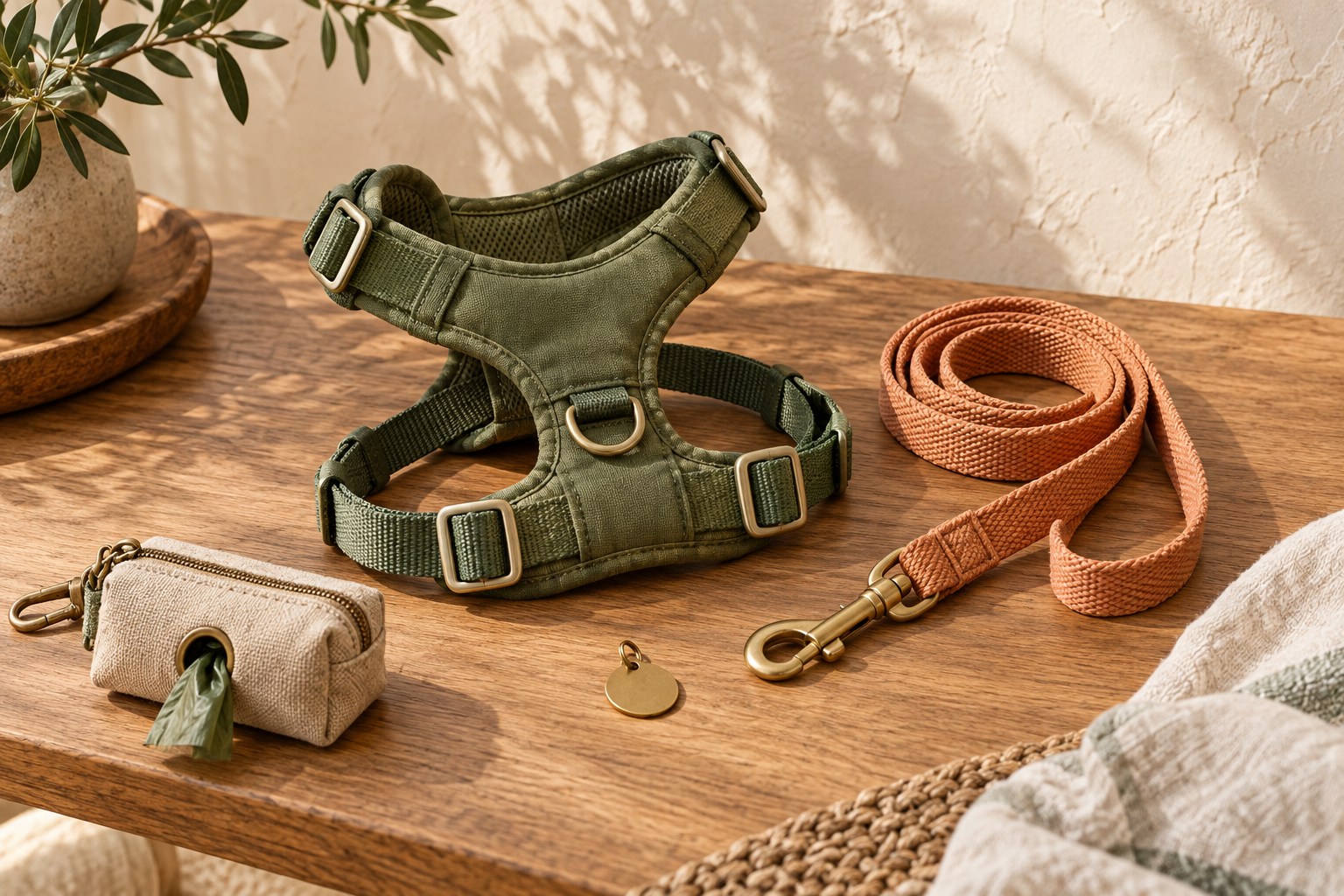
A leash ring changes the direction in which a harness receives force. A ring on the back pulls from above the body; a ring on the chest introduces a sideways component when the leash becomes taut. Neither arrangement teaches loose-leash walking by itself. The useful question is which attachment lets you handle your particular route without persistent twisting, tangling, or pressure.
A harness with both positions can provide options, provided each is used as intended.
Start with a normal back attachment
For relaxed walking, a back ring keeps the leash above the front legs and away from the muzzle. It often works neatly with a longer line because the clip is less likely to drag between the legs. Check where the ring sits once the dog moves ahead: a very rearward attachment can let the front of a loose harness lift. A back clip should not be confused with permission to allow sustained pulling; manage distance and reinforce a comfortable slack leash.
Recognize the tradeoff at the chest
A front attachment can redirect a dog’s body when tension develops, but that redirection can also rotate the harness. On a poorly matched fit, the chest panel slides toward one shoulder and the leash rubs a leg. Observe the leash path during turns. If you walk on the dog’s left, a front-connected leash crossing beneath the chest may behave differently than it does on the right. Use gentle handling and avoid abrupt corrections through any attachment point.
Decide whether two connections help
A double-ended leash can connect to chest and back rings, giving the handler a way to distribute contact. It also creates another strap to organize around gates, paws, and other people. Practice changing hand positions indoors before using it on a busy pavement. Follow the harness maker’s guidance about the intended rings: a handle loop or decorative metal fitting is not automatically a leash attachment. Keep sufficient slack that two clips are not continuously pulling against each other.
Match the setup to one route at a time
Consider a hypothetical walk that starts on a crowded sidewalk and ends in an open field. A short, organized connection may suit the first stretch; a back attachment may be more convenient for supervised sniffing on a longer line in the second. Stop in a secure place before changing clips. Check for rotation after each change, and keep rewarding voluntary check-ins. Equipment selection supports a walking routine; it does not replace the practice that makes the routine predictable.
Work through a change of direction
Consider a hypothetical dog that walks slightly ahead and to the left. With a back connection, a right turn may bring the leash along the dog’s outside shoulder while you invite it to follow. With a front connection, the same leash movement can draw across the chest and rotate the harness. Practice the turn slowly in a clear space and notice whether the dog can step naturally or has to step over the line.
Change only the connection point for the comparison. Keep the route, leash length, and pace similar so the difference is understandable. If the front arrangement repeatedly enters the legs, check ring height and harness stability before shortening the leash. Excessive shortening may remove the crossing by maintaining tension, but it does not create comfortable loose walking. A setup should permit slack during the behavior you want, rather than requiring continuous steering to remain organized.
Avoid confusing a temporary aid with a finished skill
A chest attachment may make a strong pull easier for a handler to interrupt, but the dog still needs opportunities to learn where a comfortable walking position is. Reward voluntary attention and slack, choose manageable distractions, and reduce difficulty when needed. Qualified reward-based training support can help when pulling is persistent or the handler feels physically overwhelmed.
If changing clips seems to improve a walk immediately, observe why. The dog may be walking more slowly because the equipment feels unfamiliar, or the leash may be applying pressure in a new place. Neither observation alone proves the arrangement is comfortable over time. Recheck gait, harness position, and willingness to move after several short outings. Keep notes on the specific benefit, such as fewer line crossings or easier transitions at a gate, instead of treating a particular ring as a universal solution for every walking difficulty.
Check any unused ring as well as the connected one. A loose tag or accessory attached there can enter the working leash path during a turn. Keep optional hardware minimal while comparing attachment positions so the result reflects the connection itself.
For our approach to product claims and illustrations, see the Editorial Policy.