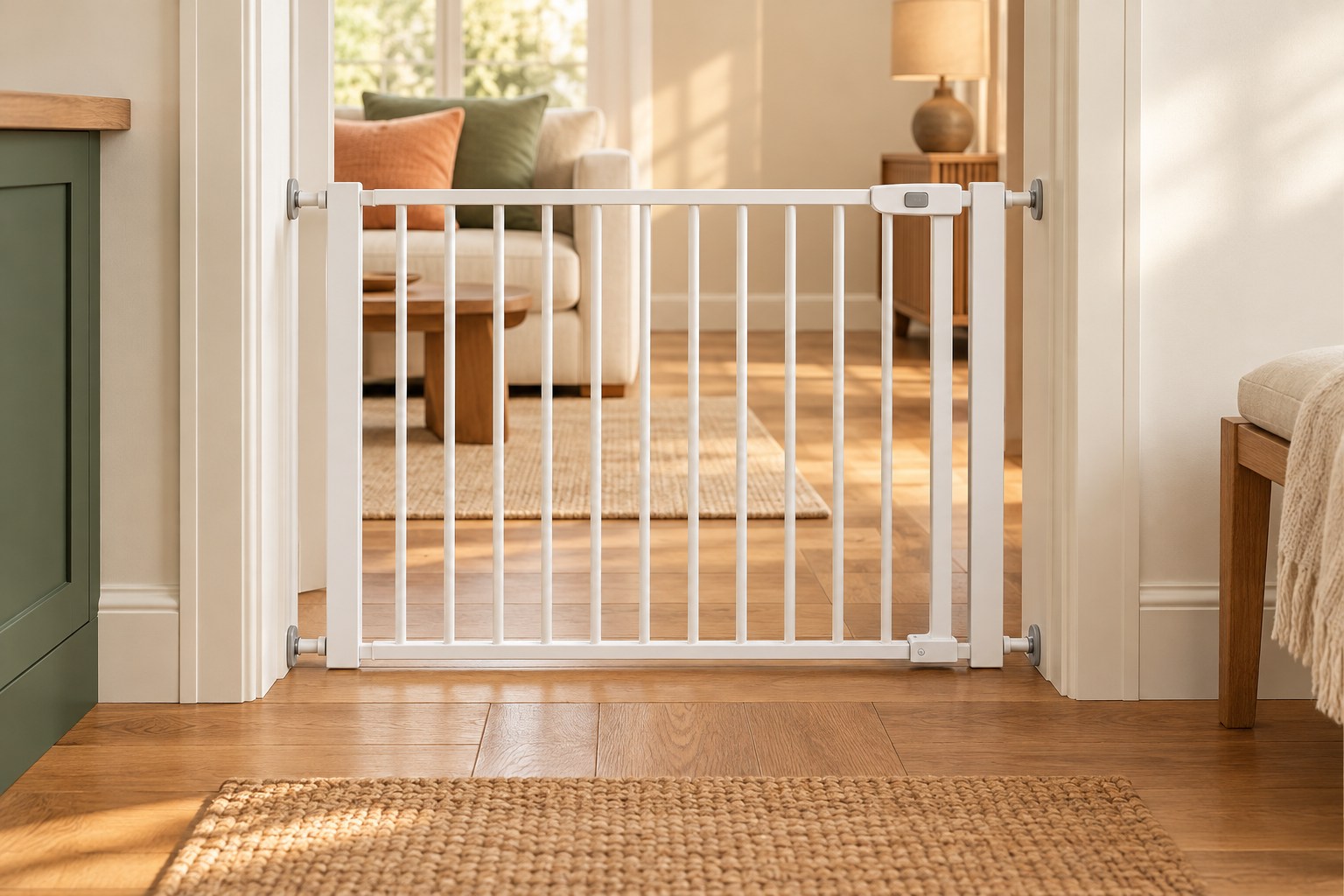
A freestanding pet barrier relies on its shape, feet, and weight rather than a fixed connection to the doorway. That can be convenient for creating a temporary supervised boundary in an appropriate setting. It also means that a determined pet may push, jump, or work around it. Decide whether that limitation matches the purpose before comparing decorative panel finishes.
Define the boundary's role
A divider used to discourage casual wandering near a quiet workspace serves a different role from containment beside stairs, an exterior exit, or a dangerous area. Do not use a lightweight freestanding barrier where movement or failure would expose the animal to a serious hazard. A suitable closed door or correctly installed barrier may be needed instead.
Consider the actual pet rather than the species pictured on the package. A calm animal that respects a visual boundary may interact differently from one that climbs or pushes. Do not treat initial hesitation as proof of lasting containment. Introduce the setup under supervision and revise it if the pet tests the edges, leans heavily, or repeatedly attempts to cross.
Understand the stabilizing footprint
Many panel dividers need a zigzag or angled arrangement to stand correctly. A product's maximum straightened width may therefore exceed its useful stable coverage. Read the intended configuration and measure the floor depth required by the angles or feet. A barrier can fit the opening width while projecting too far into the room for ordinary walking space.
Wide feet improve the base footprint but can create obstacles near a doorway. Check their placement against the household's route and the pet's approach. Avoid placing the barrier on an uneven rug or a slope unless the maker permits it. A flat stable floor and correct panel angles matter more than simply choosing a heavier-looking frame.
Inspect hinges and panel gaps
Folding panels introduce moving joints that need careful setup. Keep paws and fingers clear while unfolding and do not adjust the shape with the animal leaning against it. Check that hinges, feet, and any locks are sound. Panel spacing should be appropriate for the pet's size, including gaps created at angled joins rather than only the bars in each flat section.
Some barriers include a walk-through door. Opening that door can change balance or the usable base shape, so follow the intended operating method. A door that requires lifting the whole divider is different from a latched opening within a stable frame. Try the empty setup first and consider whether ordinary household traffic will repeatedly move it out of position.
Keep the surrounding area sensible
Furniture beside the barrier can provide a route over or around it. Cords, curtain fabric, and stored objects can also complicate the boundary. Leave a clear area where the animal can approach without becoming crowded. Do not tie a pet to the divider or use its decorative rails as anchors for a lead; those are different loads from its intended room-boundary function.
Avoid adding improvised weights or straps that create new hazards or damage the floor. If the product moves too easily, the correct response may be another format. A removable surface pad should only be used when compatible and permitted by the maker. Household ingenuity is less useful than a design whose stable configuration genuinely matches the room and pet.
Store and reassess
Fold the barrier as instructed and keep it secured out of pet access when not in use. Loose folded panels can fall or trap small items. Clean the feet and inspect the floor beneath for residue or scratches. Check hinges and panel connections before the next deployment rather than assuming that storage preserves their condition automatically.
Reassess whenever the layout or purpose changes. A divider that worked beside a desk should not be moved to a stair opening simply because it is available. The new location may demand a different product and installation. The advantage of a freestanding barrier is flexible organization within its limits, so keep those limits visible in every new use.
For our approach to product claims and illustrations, see the Editorial Policy.