Rental restrictions can make wall-mounted cat furniture impractical, but they do not make every freestanding tower suitable. Some tall products still require wall restraint. Others use pressure against a ceiling, which introduces compatibility and surface questions of its own. The right choice is a documented structure that can be installed correctly in the actual home.
Start with permissions and usable floor space, then choose climbing functions the cat will use.
Read the anchoring requirement before buying
A listing may call a tree freestanding while the instructions recommend or require a restraint for normal use. Obtain the instructions in advance if possible. If anchoring is required and cannot be permitted or installed correctly, choose a different design. Do not substitute loose weights or a strap to an unsuitable hook. A lower broad structure can provide useful height without demanding the same arrangement as a tall narrow tower.
Evaluate pressure-fit systems separately
Floor-to-ceiling products need compatible floor and ceiling surfaces, the stated height range, and correct installation. Suspended ceilings, fragile finishes, uneven surfaces, or uncertain structures may make them unsuitable. Follow the maker’s guidance and seek qualified advice where needed. Do not assume pressure mounting is automatically damage-free or permission-free. Check after installation as directed, and stop use if movement or surface damage appears.
Map complete occupied dimensions
Include platform overhangs, approach space, and descent zones, not only the base. Keep doors, radiators, blind cords, and unsecured windows clear. A hypothetical corner beside a sofa may offer a good view but leave no comfortable way down once the sofa is moved. Choose a layout that remains useful through ordinary household rearrangement. Do not rely on lightweight rented furniture as a structural support unless the product explicitly permits that arrangement.
Protect the floor without destabilizing the base
Follow guidance for the actual flooring and the furniture feet. A thick soft protective mat can make a rigid base rock, while an unsuitable rubber backing may affect some finishes. Test compatible protection as directed and inspect beneath it periodically. The aim is to preserve both floor condition and stable contact. Avoid stacking several mats to level an uneven base; resolve the flooring issue appropriately or choose another location.
Favor serviceable assembly
A product that can be dismantled with documented fasteners is easier to move than a permanently bonded complex structure. Keep instructions and labeled spare parts in a secure place away from pets. Check whether replacement posts and covers are available. During a move, block access until the tree is fully rebuilt and any required restraint restored. Do not assume a structure that was stable on one floor remains equally stable on another.
Compare simpler distributed options
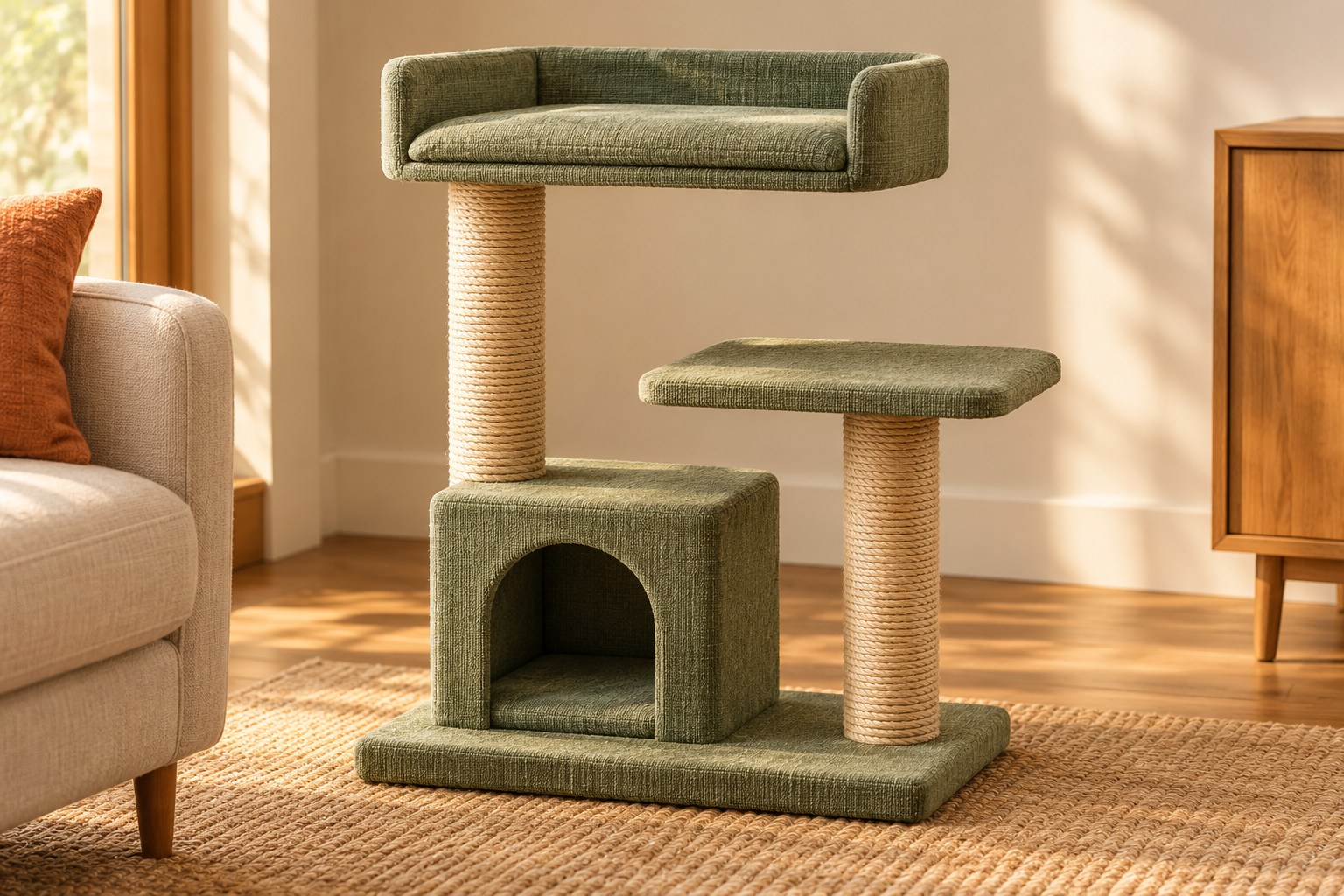
A broad low perch near a secure window and a separate scratching post may provide more usable space than one tall tower. Distribute resources without blocking human routes. In a multi-cat home, more than one location can offer independent access. Let the cat explore voluntarily and observe movement. Rental suitability is useful only if the resulting arrangement also offers comfortable platforms, sensible routes, and secure surfaces.
Plan the next home as a new installation
Record full dimensions, anchoring needs, and compatible replacement parts before packing. Inspect joints after transport and replace damaged components through the supported route. Reassess windows, cords, heaters, and landing areas in the new room. A portable product still needs a fresh fit to its surroundings. Choose furniture whose lifetime requirements remain manageable, rather than buying an imposing structure solely because its base avoids drilling on the first day.

For our approach to product claims and illustrations, see the Editorial Policy.