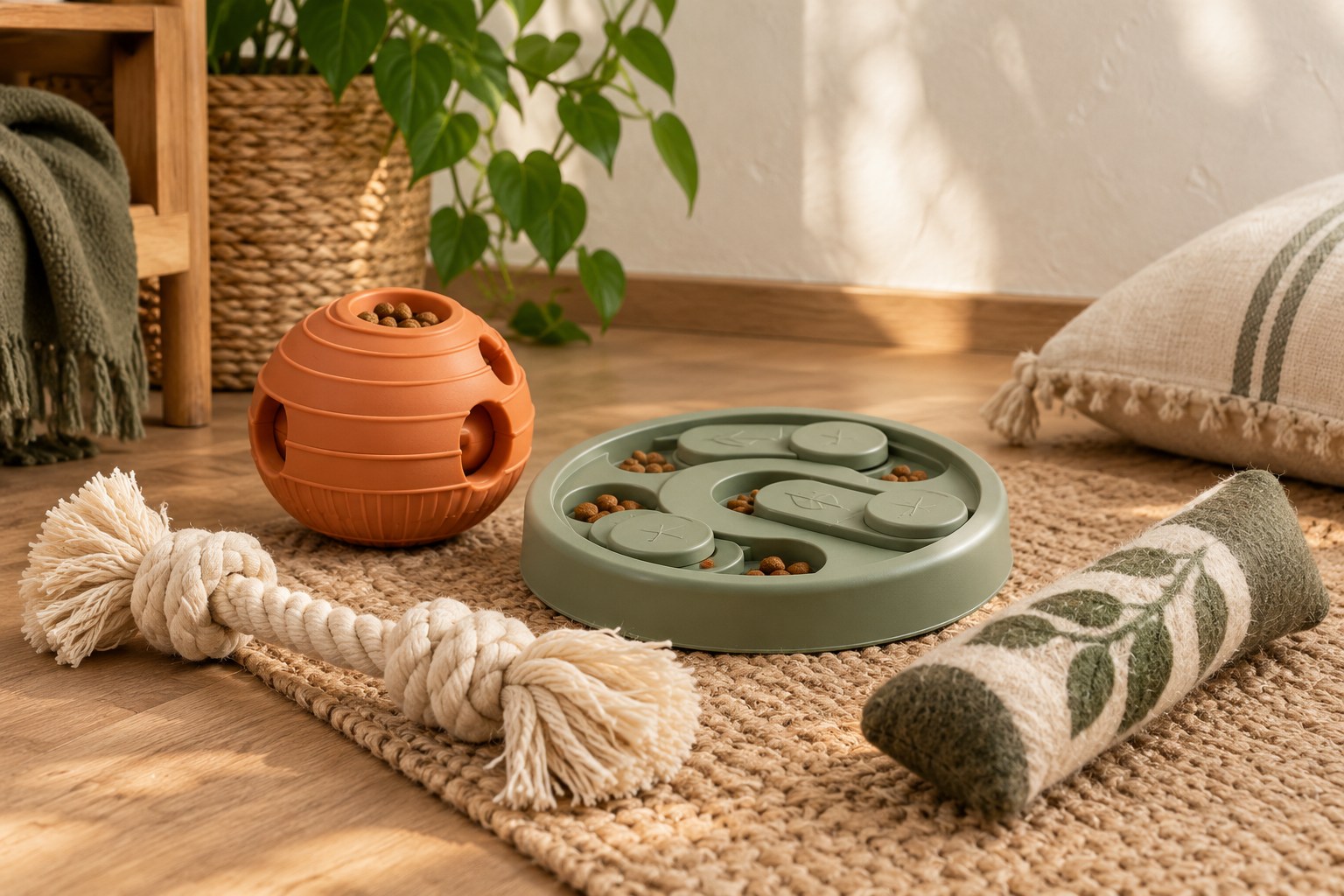
A puzzle toy combines a reward location with a physical action: slide, lift, nudge, roll, or search. For a first session, the most useful question is not how advanced the puzzle looks. It is whether the pet can discover a clear relationship between its action and the result.
Start with an accessible design and a small amount of food already suitable for the individual pet, included within its established feeding plan. Keep the session supervised. The object should provide manageable interaction, not become something the animal must dismantle or chew to reach the contents.
Choose one clear mechanism
A flat board with broad wells and one moving cover is easier to interpret than a toy combining sliding drawers, rotating discs, and removable pegs. Multiple mechanisms can be interesting later, but they make it harder to identify what is causing difficulty during an introduction.
Look for a stable base, rounded accessible spaces, and no detachable pieces that are unsuitable for the intended animal. Read the size and use guidance. An adult dog's puzzle may contain parts or clearances that are inappropriate for a small pet, even when the overall board is large.
Begin with the answer visible
Follow the maker's introductory setup. Where the design permits, leave a reward in an open well before asking for a movement. This lets the animal investigate the object and find an achievable result without having to solve a hidden mechanism immediately.
Then introduce one partial barrier, such as a cover left halfway open. Keep other wells easy. The comparison provides information: does the pet notice the partly covered area, try a gentle action, or leave it entirely? You can simplify again without treating that as a failure.
Observe the style of interaction
Some animals investigate with a nose, others use paws, and some try to pick up the whole board. The toy's weight and edges influence which actions are possible. Watch whether ordinary exploration stays within the design's intended use.
If the pet begins biting off parts, pulling fabric apart, or swallowing material, end the session and remove the toy. Increasing the reward value does not correct an unsuitable physical interaction. A sturdier-looking toy may still be inappropriate if its mechanism encourages the same destructive approach.
Adjust one variable at a time
You can change coverage, reward location, or the number of active wells. Avoid changing all three at once. For a hypothetical first board, two open wells and one half-covered well provide a clearer next step than closing every compartment after one success.
Record the action that worked rather than assigning a broad label such as clever or stubborn. A note saying moved the slider after seeing the opening is useful when setting up the next session. It also helps another household member repeat an achievable configuration.
End with an accessible result
Watch for loss of interest, repeated ineffective action, or escalating attempts to overturn the toy. Simplify or end the activity instead of trying to extract a longer session. A short, successful exploration provides more useful information than an extended struggle with inaccessible contents.
Remove the puzzle when finished, collect any remaining food, and inspect moving parts. Check underneath as well as in the wells. Food that disappears from view may be trapped in the mechanism rather than collected by the pet.
Make the next choice from evidence
If the animal comfortably uses a slider, you might offer another slider arrangement before adding a completely different action. If it consistently lifts the board, a heavier or secured design may help only if the product supports that use. Do not improvise restraints around moving parts.
After several observed sessions, decide whether the puzzle suits the animal and your cleanup routine. Difficulty labels are broad shopping aids. Your useful benchmark is repeatable, safe engagement with the actual object, followed by complete inspection and cleaning.
Distinguish discovery from repeated physical effort
A puzzle should ask for an understandable action, not excessive force. If a slider binds, a flap sticks, or a peg cannot be lifted as the manual describes, inspect the product yourself before another session. Food lodged beneath a part or incorrect assembly can create resistance that has nothing to do with the intended challenge.
Compare two hypothetical outcomes: the pet gently moves a cover once and finds the well, or repeatedly paws at a cover that barely shifts when you try it. The first suggests a discovered relationship; the second calls for a mechanical check. Difficulty descriptions do not excuse a part that fails to operate normally. Keeping that distinction clear makes both progression and product replacement more rational.
For our approach to product claims and illustrations, see the Editorial Policy.