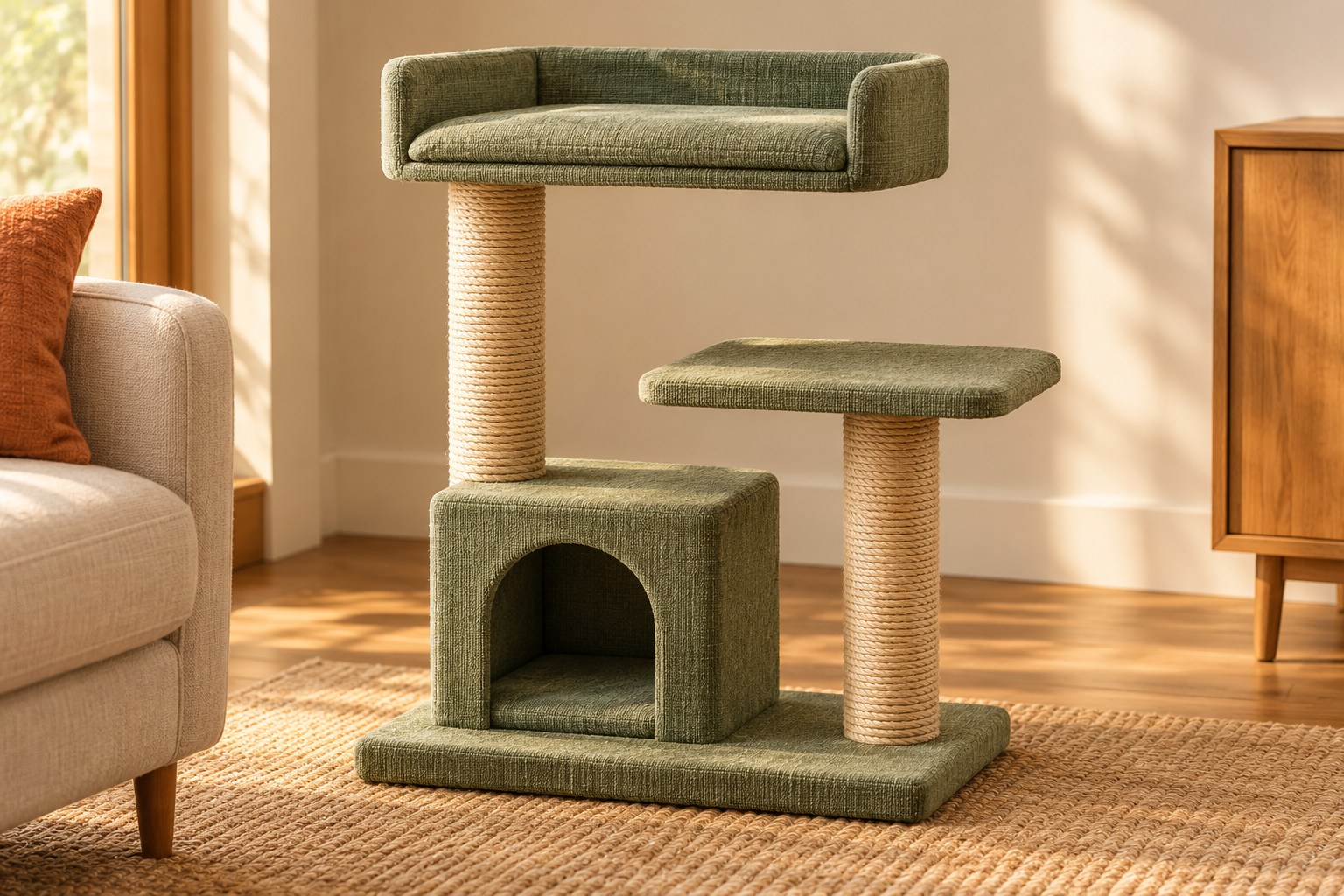
A cat tree supports movement, not a static display. Cats land on outer edges, push off sideways, and sometimes share a platform. Those forces can reveal weakness that is not obvious when the tree stands empty. Height alone does not describe stability: a shorter narrow tower with projecting platforms may behave less predictably than a taller well-supported structure.
Evaluate the load path from each usable platform through the posts to the base, and follow the manufacturer’s assembly and anchoring instructions.
Read the footprint as a working area
The base needs to support the way the upper structure projects. Look at the widest platform and whether it extends far beyond the base on one side. A decorative thin base may occupy a large rectangle without providing much mass or rigidity. Check the full assembled dimensions, including overhangs, and mark them on the intended floor. A hypothetical tree fitted into a narrow alcove can still be unstable if the top platform projects into the open room where the cat lands.
Check how platforms are supported
A platform resting on two separated posts has a different support pattern from one attached at a single corner. Cantilevered shelves are not automatically unsuitable, but their construction, fasteners, and stated load limits matter. Read whether a weight limit applies to one platform, the whole tree, or a particular component. Do not add the weights of several cats and assume a single advertised maximum explains every use. If documentation is unclear, ask the maker before purchase.
Inspect the connection system
During assembly, lay out the supplied parts and identify the correct screw for each location. Similar-looking fasteners may have different lengths. A screw that is too long can project through a platform; one that is too short may not engage properly. Tighten according to instructions without crushing composite material. Check that posts seat squarely and that covered surfaces do not conceal a gap at the join. Keep packaging and small parts away from cats until assembly and inspection are complete.
Use only supported anchoring
If the manufacturer provides or requires a wall restraint, install it using suitable fixings for the actual wall and the stated method. Seek a qualified installer when the substrate or hidden services are uncertain. A loose strap to an unsuitable hook does not create dependable support. Do not substitute a pressure-fit arrangement or improvised weight for required anchoring. In rental housing, confirm permissions and choose a compatible freestanding design if approved anchoring cannot be achieved.
Test the intended floor
A thick rug can let a base rock; uneven boards can leave one corner unsupported. Place the assembled tree where it will be used and gently check for rocking without climbing on it or exceeding its stated limits. Keep it away from hazards such as blind cords, open windows, heaters, and furniture that could tip if used as a launch point. Leave a clear landing area. Stability is affected by the room around the tree as well as by its own parts.
Introduce and observe real movement
Let the cat investigate voluntarily, using familiar routes or rewards without lifting it onto a high platform. Observe a few ordinary climbs and departures from a safe distance. If the base shuffles, a post rotates, or a platform visibly flexes in an unexpected way, stop access and inspect. Do not ask the cat to keep using a moving tree until it gets used to the motion. A structural problem requires correcting the structure or choosing another product.
Plan maintenance before buying
Ask whether posts, covers, and fasteners can be replaced and whether assembly instructions remain available. Recheck connections at the intervals specified and after moving the tree. Scratching wear can eventually expose structural joints, while repeated jumping can loosen parts that were initially secure. Keep a record of the model and replacement dimensions. A serviceable tree with accessible joints is often easier to keep useful than a complex structure whose fixings are hidden beneath permanently bonded fabric.
Compare two similarly tall designs
Imagine two trees of equal height. One has a broad base, two widely spaced posts, and an upper platform centered above them. The other has a narrow base, one central post, and a wide shelf projecting sideways. The second design asks its connections and any restraint to manage more leverage when a cat lands on the outer edge. Its suitability depends on documented engineering and correct installation, not visual similarity in height.
Now place each on a thick rug. A previously flat base may rock, revealing that floor contact changes the system again. This comparison shows why stability cannot be reduced to a single measurement. Examine geometry, connection quality, intended limits, floor support, and required anchoring together before deciding which product fits the room.
For our approach to product claims and illustrations, see the Editorial Policy.