Several litter boxes placed side by side may look like generous provision, yet they can function as one location from a cat’s perspective. The same approach, neighboring animal, or noisy appliance affects every box at once. Distribution is about independent access as much as the number of containers.
Plan locations around the home’s actual routes and the individual cats, and seek veterinary or qualified feline behavior guidance when toileting difficulties or conflict appear.
Map access from the cat’s viewpoint
Walk the routes between favored resting areas and possible litter locations. Identify narrow passages, closed doors, stairs, and places where another cat tends to wait. A hypothetical box in a spacious basement may still be difficult to reach if the only stairway is frequently blocked. Avoid assuming that a physically open route feels equally accessible to every cat. Watch quieter pauses and retreats, not only overt chasing or confrontation.
Create genuinely distinct choices
Separate locations can offer alternatives when one area becomes busy or uncomfortable. Two boxes touching each other do not provide the same independence as resources in different suitable areas. Consider floors and frequently used rooms without placing boxes beside food or water. Exact arrangements depend on the home and the cats, so use qualified guidance when needed. The goal is convenient voluntary access rather than maximizing the number of boxes that fit into one visually discreet cupboard.
Avoid predictable disturbances
A washing machine, a door that bangs, or a busy passage can interrupt access. Choose reasonably quiet locations that remain reachable throughout the day. Avoid hiding a box behind a door that is sometimes shut. If children or other animals use the space, manage their access so the cat is not disturbed during toileting. A location is only available if household routines consistently preserve it.
Keep approach and departure workable
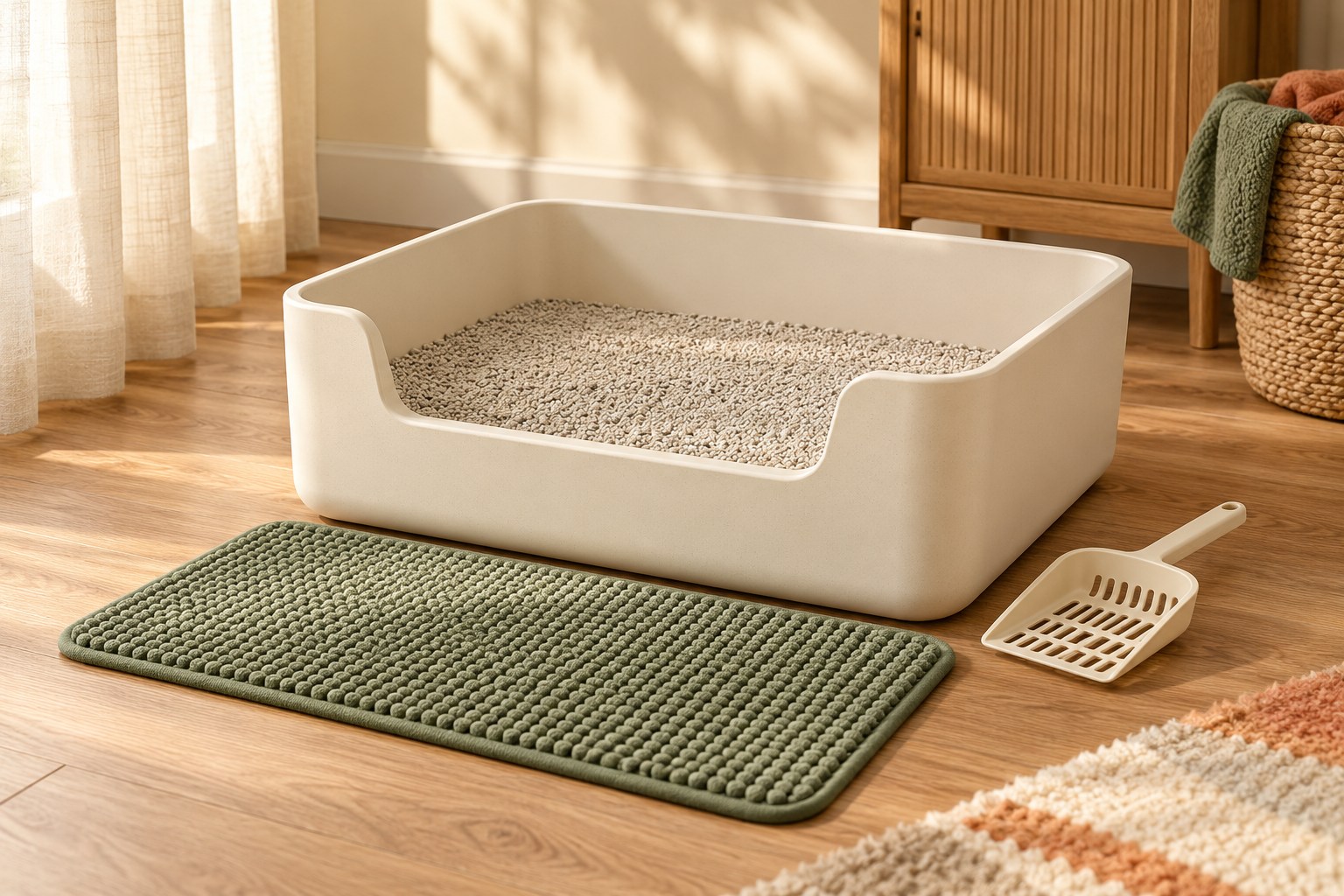
An enclosed cabinet or deep corner can create a single exit. Some cats use that comfortably, while others may be reluctant when another animal approaches. Favor clear sight lines and enough space to turn outside the box. Barriers intended to manage other pets should not create a squeeze or a high obstacle for the cat. A simple open location may serve better than an elaborate hidden enclosure if it offers more reliable access.
Make maintenance possible everywhere
Distributed boxes need a maintenance routine that covers every location, not only the most visible one. Keep suitable supplies accessible and inspect each box regularly. If a remote location is repeatedly overlooked, adjust the routine or choose a more workable location. Do not use a covered box to conceal delayed waste removal. Check that the box itself remains appropriately sized and accessible; location planning cannot compensate for a cramped interior or difficult entrance.
Observe individual use without forcing it
Cats may use different boxes for different reasons or change preferences over time. Keep a simple record if access is uncertain, especially after a new cat arrives or furniture is rearranged. Introduce new locations while preserving familiar suitable options when feasible. Do not repeatedly place a cat in a box to encourage use. New avoidance, straining, frequent attempts, or other changes need prompt veterinary assessment; environmental adjustments are useful alongside appropriate care, not as a reason to postpone it.
Review a location during a busy household hour
A room can appear quiet during the day and become crowded when everyone returns home. Observe access during ordinary busy periods: doors opening, laundry running, children passing, and other animals moving between rooms. A litter location should not depend on an unusually calm snapshot of the household.
For a hypothetical upstairs box, check whether the stair route remains available when a dog rests on the landing. For a downstairs box, check whether a utility door is routinely closed in the evening. These details can make a physically present resource functionally unavailable without anyone intending to block it.
Make one practical change at a time and preserve suitable familiar access. Moving all boxes simultaneously can make it difficult to understand the effect of the new distribution. Keep records simple: which location is used, whether the approach is clear, and whether another animal is nearby. If patterns remain difficult or toileting changes appear, combine environmental review with veterinary and qualified behavior advice rather than repeatedly rearranging containers without an assessment.
Include visitors and temporary closed rooms in the access plan. If a guest stays in the room containing a frequently used box, preserve an appropriate alternative before the stay begins. Predictable access should continue through ordinary disruptions, not only during the household’s usual week.
For our approach to product claims and illustrations, see the Editorial Policy.