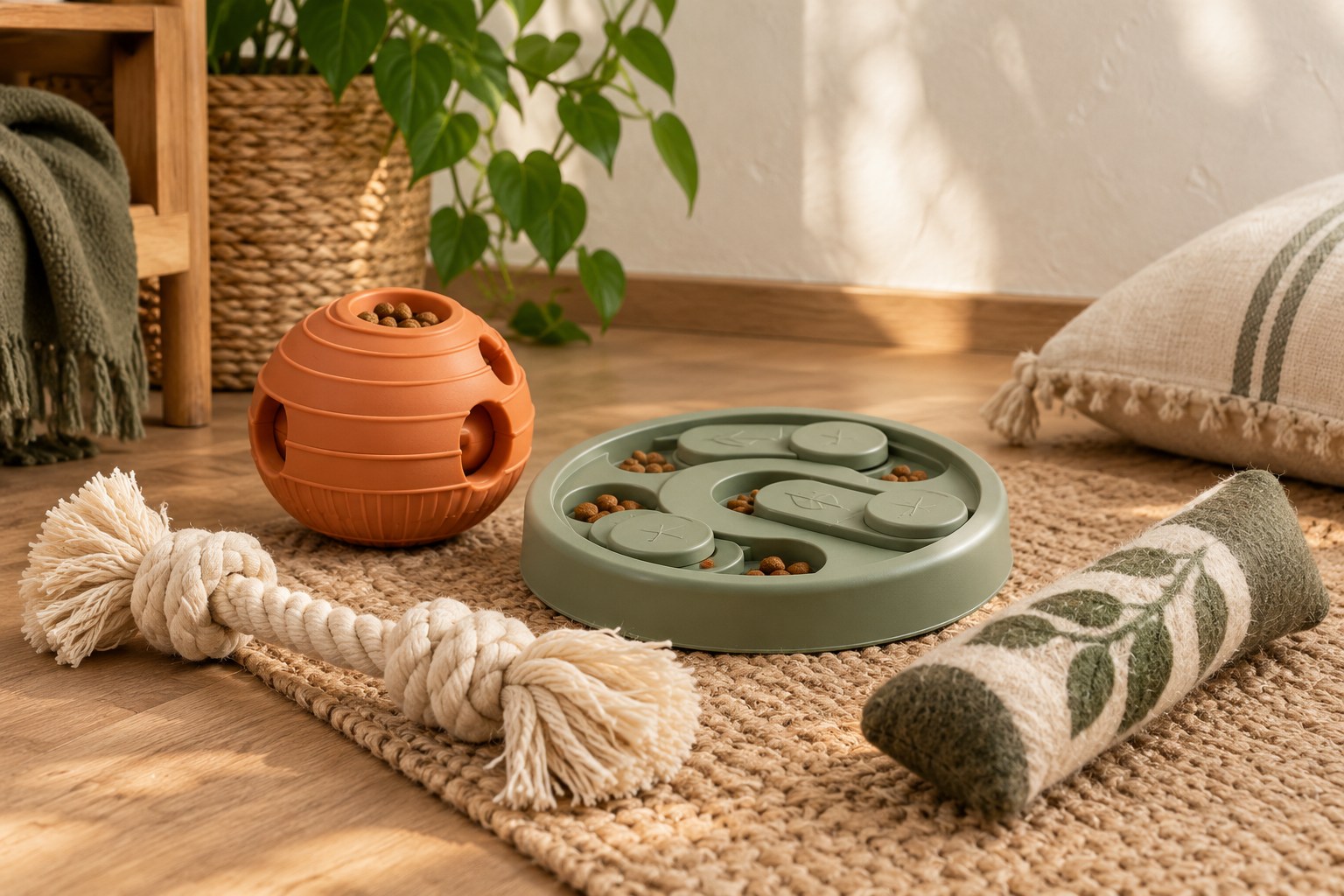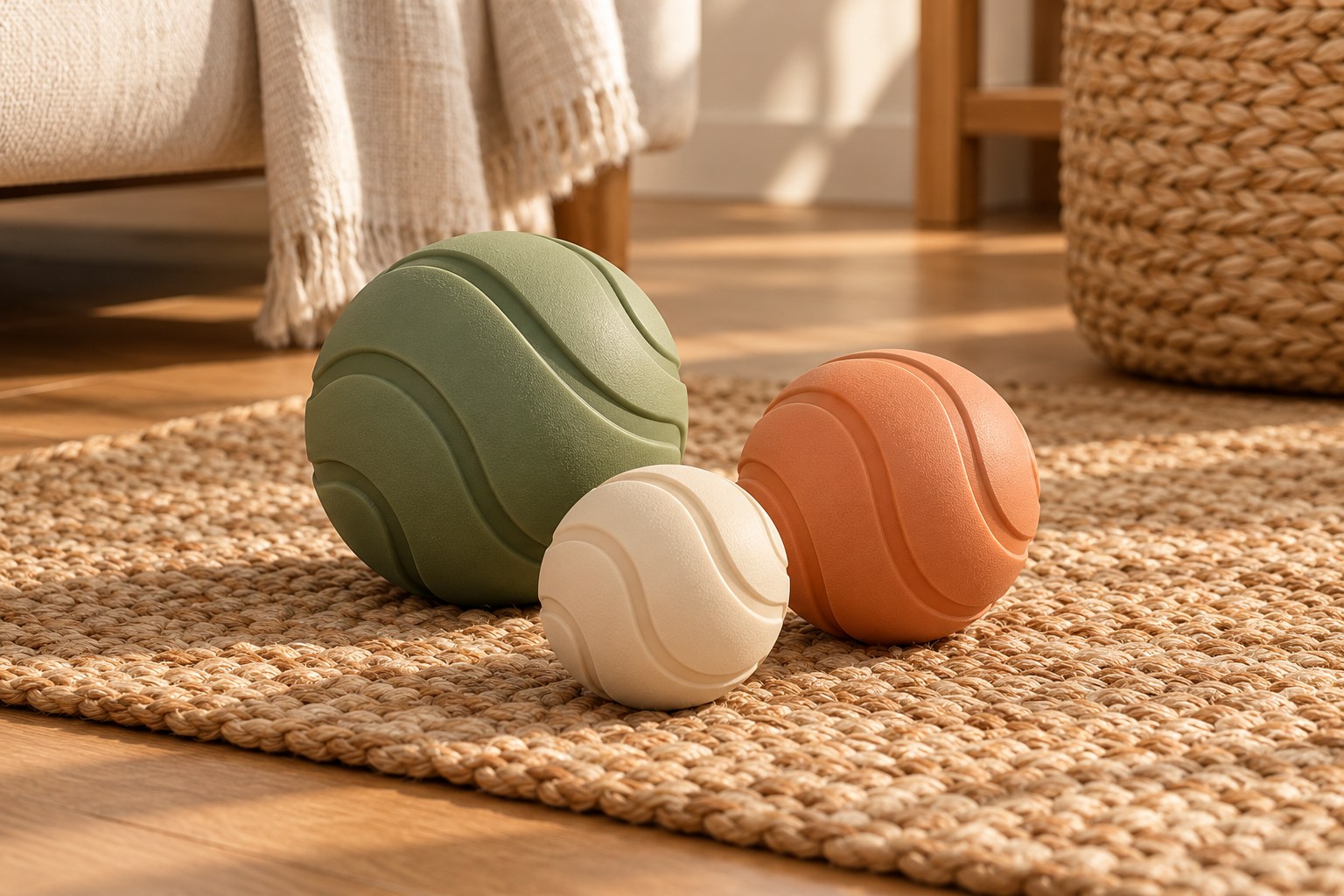
A ball is a compact toy with a large range of possible behaviours. It can compress, bounce, roll under furniture, or disappear against grass. Before considering a launcher or a special texture, choose a size and construction explicitly intended for the animal using it.
No single diameter is a universal answer for every dog. Follow the manufacturer's size guidance and choose a ball that cannot be swallowed or become lodged in the mouth. If the fit is uncertain, select another appropriate toy and ask a qualified professional for individual guidance rather than experimenting with a too-small ball.
Start with the whole ball
Measure the ball itself, not the package or launcher cup. Check whether it is solid, hollow, soft, or readily compressible. A ball that looks large at rest can behave differently when squeezed. Consider its compressed form alongside its stated size and intended use.
Avoid repurposing small sports balls or decorative objects simply because the dog shows interest. Materials, seams, coatings, and size may be unsuitable. A product marketed for pets still needs inspection and an appropriate size; the label does not remove the need to supervise.
Think about retrieval grip
Raised texture can offer grip but also collect dirt. Deep grooves may become places where the animal concentrates chewing. A smooth ball may be easy to wipe but slippery when wet. Look at the complete surface and the pet's observed handling rather than assuming more texture is always better.
Some balls include holes or handles. Check that these are part of the intended design and suitable for the animal. Do not add cord through a ball to make it easier to hold unless the maker provides and supports that arrangement. An improvised loop changes the toy's risks and movement.
Match visibility to the ground
Compare the ball against the actual play surface. A colour that looks bright on a white shop background may be difficult to find in dry leaves or long grass. High contrast and a simple distinctive outline can make retrieval easier for the person too.
For a hypothetical garden with mixed grass and brown leaf litter, carry the candidate to that background before buying several. Photographing it from standing height can help reveal how much it blends in. Visibility is a practical feature when a lost ball would remain outdoors and deteriorate unnoticed.
Treat launcher fit as secondary
A launcher specifies compatible ball dimensions, but that compatibility does not establish suitability for the dog. Start with the appropriate ball and then find a supported launcher, if one is wanted. Do not force a larger ball into a cup or use a smaller one that the maker does not permit.
Check the ball after each session for wear caused by both the animal and launcher. Cracks, torn outer layers, exposed cores, or parts breaking away are reasons to remove it. A familiar favourite should not remain in service merely because it still rolls.
Plan a controlled session
Choose a clear area with suitable footing and manageable distances. Keep throws within the space and the animal's abilities, avoiding abrupt changes around obstacles. A ball's energetic bounce can carry it farther than the initial throw suggests, so leave room beyond the intended landing point.
End by collecting every ball and checking its condition. Store clean, dry toys out of reach if they are intended for supervised fetch rather than chewing. Buying two verified suitable balls can make exchanges practical, but accumulating many sizes makes it easier for an unsuitable one to enter the session.
For our approach to product claims and illustrations, see the Editorial Policy.