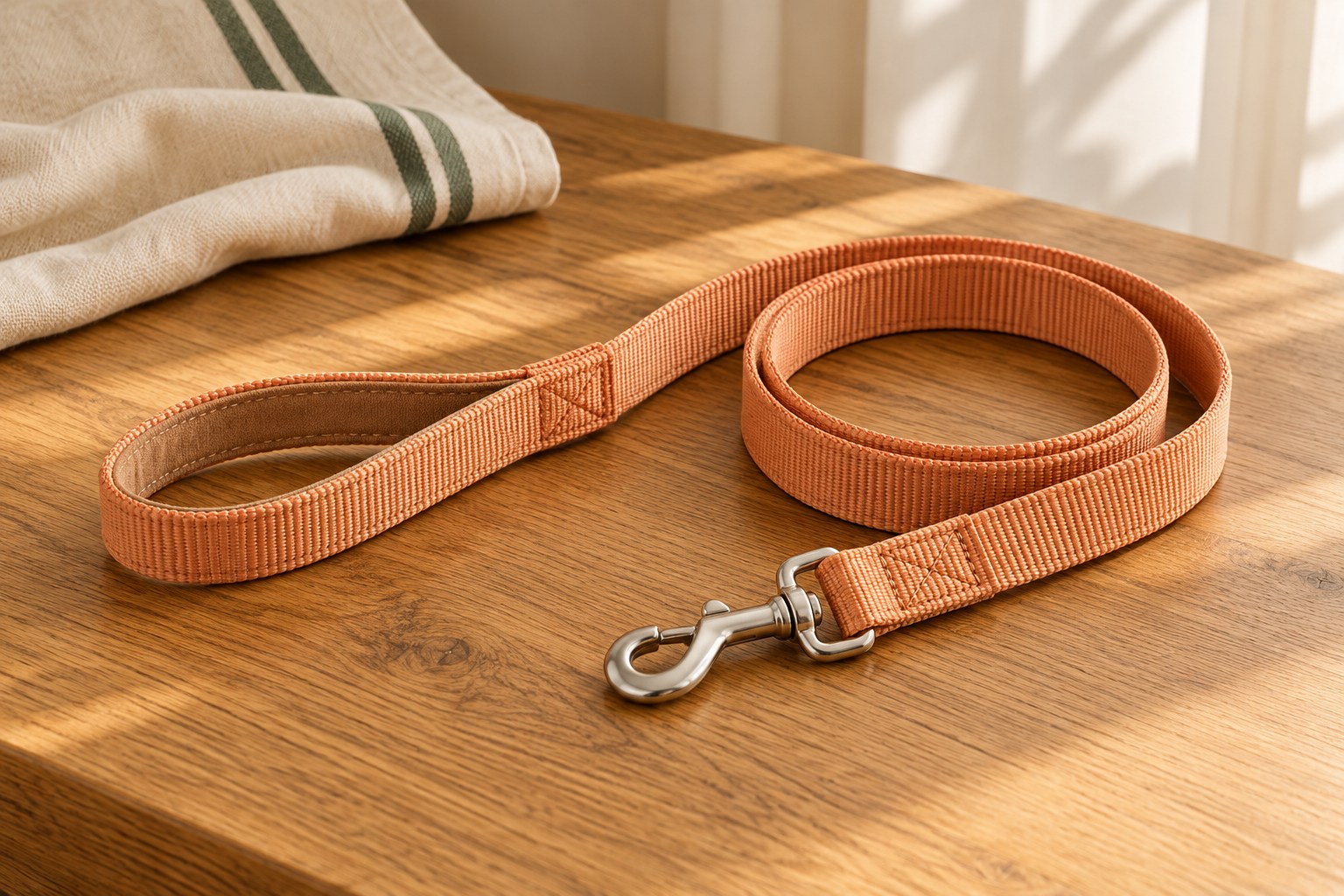
Leash length is a route decision. A quiet verge offers different opportunities from a narrow pavement beside traffic, and one fixed length may not feel equally convenient everywhere. Buying the longest option for freedom can leave a pile of spare webbing in your hands. Buying the shortest can prevent ordinary sniffing without improving your handling.
Map the moments when you need the dog close and the moments when extra distance has a purpose.
Measure the walking space
Think about the narrowest sections you use every day: a building entrance, a shared path, a bus stop, or a crossing island. A leash should let the dog stand comfortably beside you without needing constant tension, while allowing you to gather extra length before entering those spaces. Check local rules where a maximum length is specified. Rules can vary between parks, streets, and protected areas, so do not assume the same setup is accepted throughout an entire neighborhood.
Understand usable distance
The advertised length runs from the handle to the attachment, but part of that distance is occupied by your arm position and the dog’s harness location. A tall person walking a small dog needs more vertical allowance than a short person walking a large dog. Try a hypothetical standing position: can the dog lower its head to sniff near your feet without the leash lifting its harness? A leash that remains taut during this ordinary action may simply be too short.
Make shortening deliberate
Gather slack in broad folds without wrapping it around fingers, wrists, or the dog’s body. Practice moving from your relaxed length to a shorter length before a crossing, rather than waiting until a bicycle appears. Some leashes include a lower handle, but its location should match your height and the dog’s size. A handle close to the clip may require bending awkwardly, and holding it should not force the dog’s head upward or prevent comfortable steps.
Separate ordinary walks from open-space work
A moderate fixed leash often handles urban errands well, while a separate long line can serve controlled sniffing in suitable open areas. Trying to make one very long leash do both jobs adds unnecessary handling. Conversely, a short leash does not become appropriate for every setting because it fits in a pocket. Evaluate the finished routine after several outings: note where you repeatedly gather too much material or cannot offer enough slack, then choose the next length based on those observations.
Build a route-based comparison
Write down three ordinary segments: the entrance, the narrowest pavement, and the place where the dog usually sniffs. For each, note whether your current leash leaves too much spare length, remains comfortably slack, or becomes taut before the dog can move naturally. This small record can reveal that only one segment needs a change in handling rather than a completely different product.
For example, a hypothetical owner may want extra length on a grass verge but repeatedly gather a large loop near shops. A moderate fixed leash plus an occasional separate open-space line may be simpler than carrying the longest possible lead every day. Another owner may discover that the current leash is adequate once the bag and dispenser are moved away from the handle, leaving room to gather folds comfortably.
Before buying, compare total length with usable handle-to-dog distance while standing beside the actual dog. Clips, adjustable loops, and tall attachment points all affect the result. Choose from those observations rather than assuming a commonly advertised length will feel the same for every walking pair.
For our approach to product claims and illustrations, see the Editorial Policy.